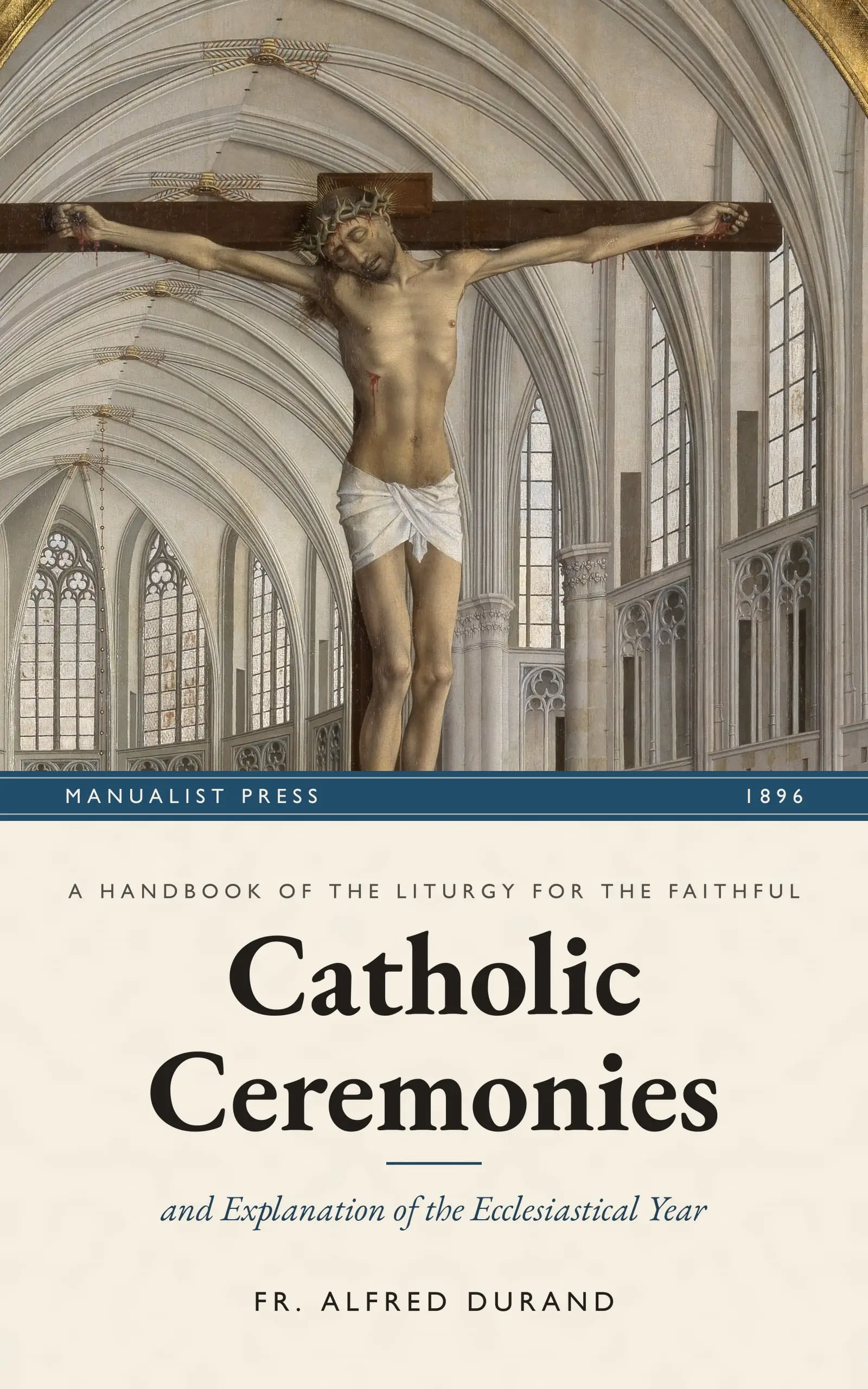
Catholic Ceremonies
And Explanation of the Ecclesiastical Year
Fr. Alfred Durand, 1896
In some old churches the columns do not line up, and Fr. Durand says this was no mason’s mistake. The builders were quoting a verse applied to Christ on the cross, “All My bones have been displaced,” and a nave that leans toward Our Lady’s chapel is the Son’s head bending toward His Mother. That is how this book reads a church and everything done in it.
Most of it follows the Mass from the prayers at the foot of the altar to the Last Gospel as the life of Christ told in sequence. The Introit is the Incarnation, the Gloria is the song at Bethlehem, the Offertory is the Last Supper, and the priest’s low voice through the Canon is Christ silent before His judges, raised only seven times, once for each word spoken from the cross. The vestments carry the Passion in the same way. The amice is the cloth tied over a condemned man’s head, and the stole is the rope that led Him to Calvary.
Sunday Vespers is explained psalm by psalm, with the five psalms placed in the five wounds, and the year is taken feast by feast with the stories behind the customs, from the three Masses of Christmas to the bells that fall silent on Holy Thursday. The Latin and English of the Ordinary of the Mass, Sunday Vespers, and Benediction are printed at the end, so the book serves as a missal companion in the pew, and the drawings of the articles used at church ceremonies, each with its proper name, are carried as plates. Durand wrote for Catholics who were, in his words, blind spectators at their own ceremonies, and the book still does that job.
The first page of The Altar

Chapter I
The Altar
Form of the Altar.—The Catholic altar has always been a table or a tomb. This double form has perpetuated through the ages the remembrance of the institution of the Eucharist and of the burial of Our Lord. The cloth that covered the table at the last supper, the winding-sheet of the Saviour’s embalming, are recalled to our love by the white linens spread upon it. The altar, the eucharistic table, the mystical tomb, is, above all, the holy mountain where Jesus Christ transfigures and immolates Himself at the same time; raised as it is above the ground, it appears to us always as a Thabor and a Calvary. Happier we than the apostle, for we can make for ourselves there a perpetual dwelling-place, even in the heart of the divine Saviour.
The Sacred Stone.—During the Mass the priest often kisses the middle of the altar. In this spot is a stone become, by the consecration of the bishop, a figure of Jesus Christ.
Contents
Related Books
Check your inbox
Confirm from the email we sent before any prayers arrive.
Edition & sources
Edition
- Source edition
- Catholic Ceremonies and Explanation of the Ecclesiastical Year, New York, Benziger Brothers, 1896
- This edition
- Manualist Press, September 2026
- Paperback
- 228 pages, 6 × 9 inches, ISBN 9798173256881
- Hardcover
- 228 pages, 6 × 9 inches, ISBN 9798173260055
- Kindle
- ASIN B0H763DXPC
- Plate
- Calendar page for May, leaf from a book of hours, about 1510. Cleveland Museum of Art.
Translated from the French of Fr. Alfred Durand and published by Benziger Brothers in 1896, with nihil obstat and imprimatur.
Thank you.
Report a mistake
Manualist Press is a small family press. If these pages help you pray, you can support the work.
