The Divine Plan of the Church: Where Realised, and Where Not
Fr. John MacLaughlin · 1901
Paid links: as an Amazon Associate I earn from qualifying purchases.
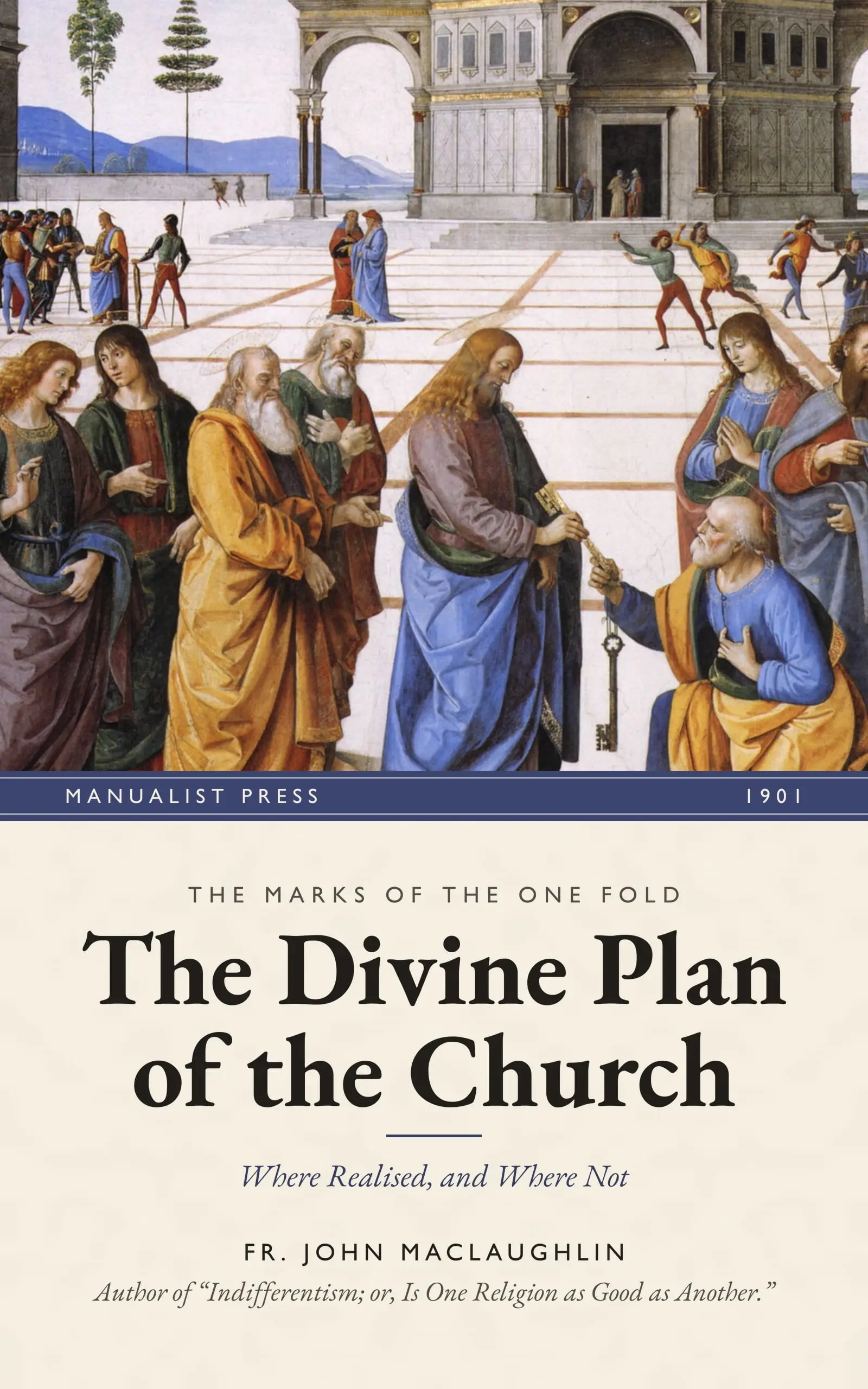
Arguments about which church is the true one tend to drift into history and get lost there. Fr. John MacLaughlin keeps his out of it. He begins with the second of the Thirty-nine Articles, which Anglican clergy subscribe: Jesus Christ is very God. A God who gave Noah the ark’s measurements down to the pitch did not leave his Church to be built by guesswork. Private judgment could have no place in such a plan; he calls the idea a square circle. Nor could the plan allow a Church that goes wrong after six centuries, an ark built to sink on the sixth day of the flood. From there the steps are short, and they end at one teacher who cannot err. Once that teacher is found, he says, all controversy may cease.
More
The second half turns to the Church of England and lets her own people describe her: the historian Green, Bishop Warburton, Sir William Harcourt, the Duke of Argyll, The Times. MacLaughlin keeps the odd documents too, such as the license by which Edward VI let Archbishop Cranmer eat meat in Lent, and Elizabeth’s command that the fasting days be enforced, with the frank explanation that it was to set men fishing for the good of the navy. An appendix answers the three cases left standing against papal infallibility, Liberius, Honorius, and Galileo.
He wrote for ordinary readers rather than scholars, he says, and without irony or sarcasm, and it reads that way. If you want one argument for the Church that you can carry in your head, this is where to get it.
The first page of The Key to the Building

The Key to the Building
The Love of Truth and Firm Belief in the Incarnation
It may be said with reason, that at the present day there is hardly a word in the language which is so abused, perverted, wrested to so many wrong and anomalous meanings as the word truth.
It would be difficult indeed to point to anything of which there are so many counterfeits and delusive semblances as objective truth. And what is a most unseemly paradox, is, that the meaning of the word appears to have been more severely handled, more shockingly mangled in what is supposed to be the sphere of religion than in any other sphere. For, within the whole range of what is called revelation, there is scarcely a doctrine of which contradictory statements have not been pressed upon the acceptance of the Christian community for belief.
“As if,” observes Cardinal Manning, “truth were a sort of coin that they (men) may stamp and change, and vary its die, and fix its value, and make it in metal or paper as they will. They treat truth as one of the elements of human barter.”
Related Books
Check your inbox
Confirm from the email we sent.
Edition and sources
Edition
- Source edition
- The Divine Plan of the Church: Where Realised, and Where Not, London, R. & T. Washbourne, 1901
- This edition
- Manualist Press, September 2026
- Paperback
- 196 pages, 6 × 9 inches, ISBN 9798173433978
- Hardcover
- 196 pages, 6 × 9 inches, ISBN 9798173435033
- Kindle
- ASIN B0HJGHCC5L
- Plate
- Christ Giving the Keys to St. Peter, after Cornelis Cort, about 1567. Cleveland Museum of Art.
Set from the R. & T. Washbourne edition, London, 1901, with Cardinal Vaughan's preface.
Thank you.
Report a mistake
Manualist Press is a small family press. If these pages help you pray, you can support the work.