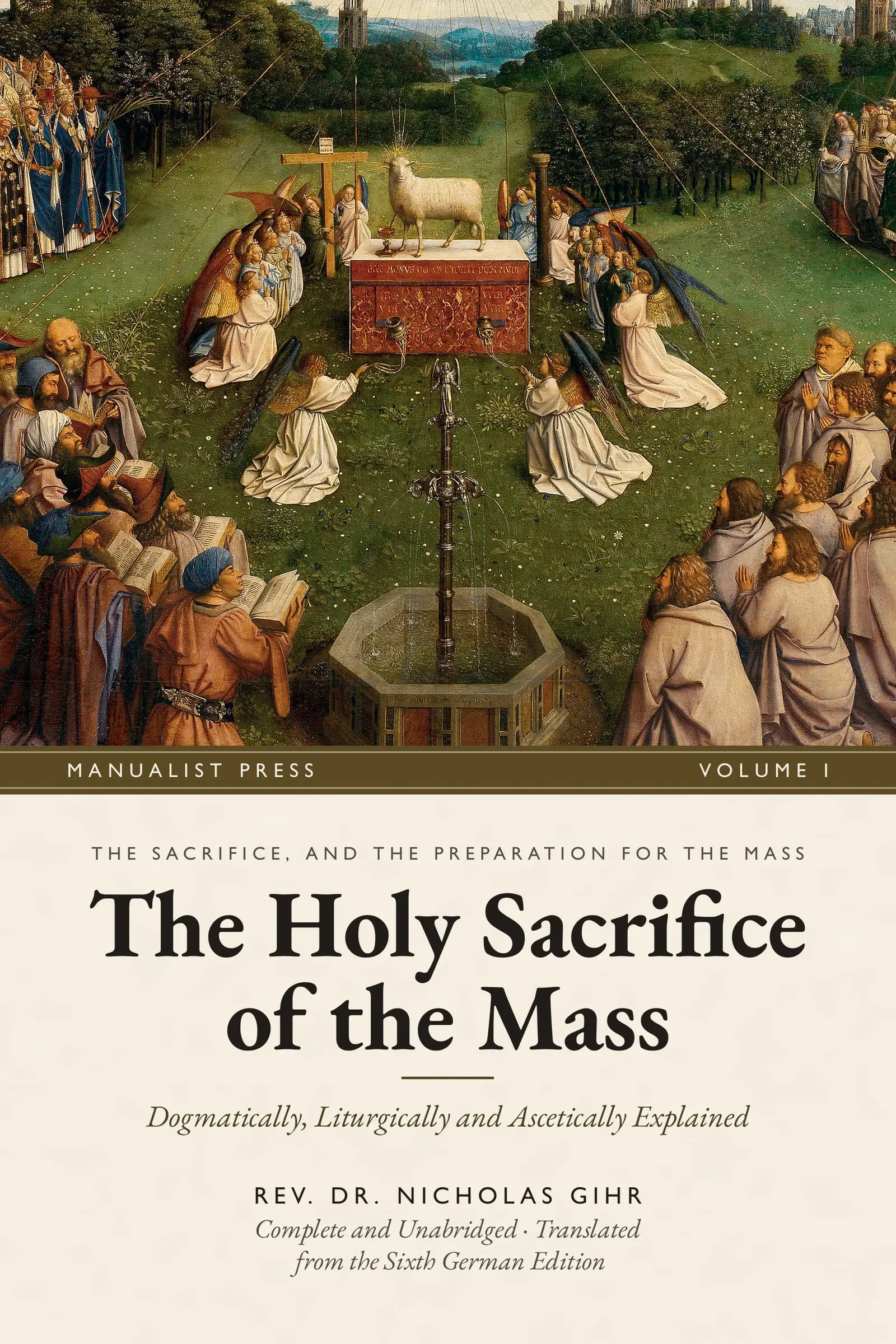
The Holy Sacrifice of the Mass, Volume I
Dogmatically, Liturgically and Ascetically Explained
Rev. Dr. Nicholas Gihr, 1902
Every Catholic has heard that the Mass is a sacrifice. Dr. Nicholas Gihr wrote this book to show why that is true, and to show a priest what he is doing when he stands at the altar. Book One is the argument. It begins with what a sacrifice is at all, follows the question through the offerings of the Old Law to the Cross, and then proves that the Mass is that same sacrifice offered without blood: from Melchisedech’s bread and wine, from the clean oblation foretold by Malachias, from the present tense of the words at the Last Supper, and from the Fathers and the ancient liturgies. Gihr is just as exact about what the Mass obtains. He sorts out the fruit that goes to the whole Church, the fruit for those who are present, the fruit for the priest, and the fruit a priest applies by intention, and he explains why the Church says many Masses for one soul and why a High Mass obtains more than a low one.
The first chapter of Book Two completes this volume and walks up to the altar: why it must be stone and what lies sealed inside it, how it is dressed, the chalice and its linens, the six vestments and the virtue each one asks of the man who puts it on, the five liturgical colors, the wax candles, and a long defense of Latin as the language of the Mass. Each answer comes with the Church’s own prayers and decrees in hand.
Gihr wrote for priests and arranged the book so that an educated layman could read it with profit. This is the first of two volumes. Volume II goes through the rite itself.
The first page of Sacrifice in General

Chapter I
Sacrifice in General
1. On the Virtue of Religion
Sacrifice is an act and, in fact, the supreme act of religion, for by the offering of sacrifice the Divine Majesty is honored in the worthiest and most perfect manner. The virtue of religion is, so to speak, the very root whence sacrifice springs and develops as a most beautiful blossom and most precious fruit. Therefore we at once perceive that the way for a better understanding of sacrifice can be opened only by previously considering the Christian or supernatural virtue of religion in its principal characteristics.
1. Religion (religio) is a special moral virtue, which enables and inclines the will to give to God the supernatural honor and adoration due to Him as the Creator and Supreme Ruler, as well as the last end of all things, and particularly of man. The Holy Ghost plants this virtue in the garden of the soul; it is our duty, with the help of grace, so to nourish this noble and precious gift of heaven that it may bear abundant fruit for the honor and glory of God and our own blessing and ultimate salvation.
Contents
Related Books
Check your inbox
Confirm from the email we sent before any prayers arrive.
Edition & sources
Edition
- Source edition
- The Holy Sacrifice of the Mass: Dogmatically, Liturgically and Ascetically Explained, St. Louis and Freiburg im Breisgau, B. Herder, 1902
- This edition
- Manualist Press, September 2026
- Paperback
- 360 pages, 6 × 9 inches, ISBN 9798174894815
- Hardcover
- 360 pages, 6 × 9 inches, ISBN 9798174896949
- Kindle (Volumes I–II)
- ASIN B0HK2HP8LH
- Plate
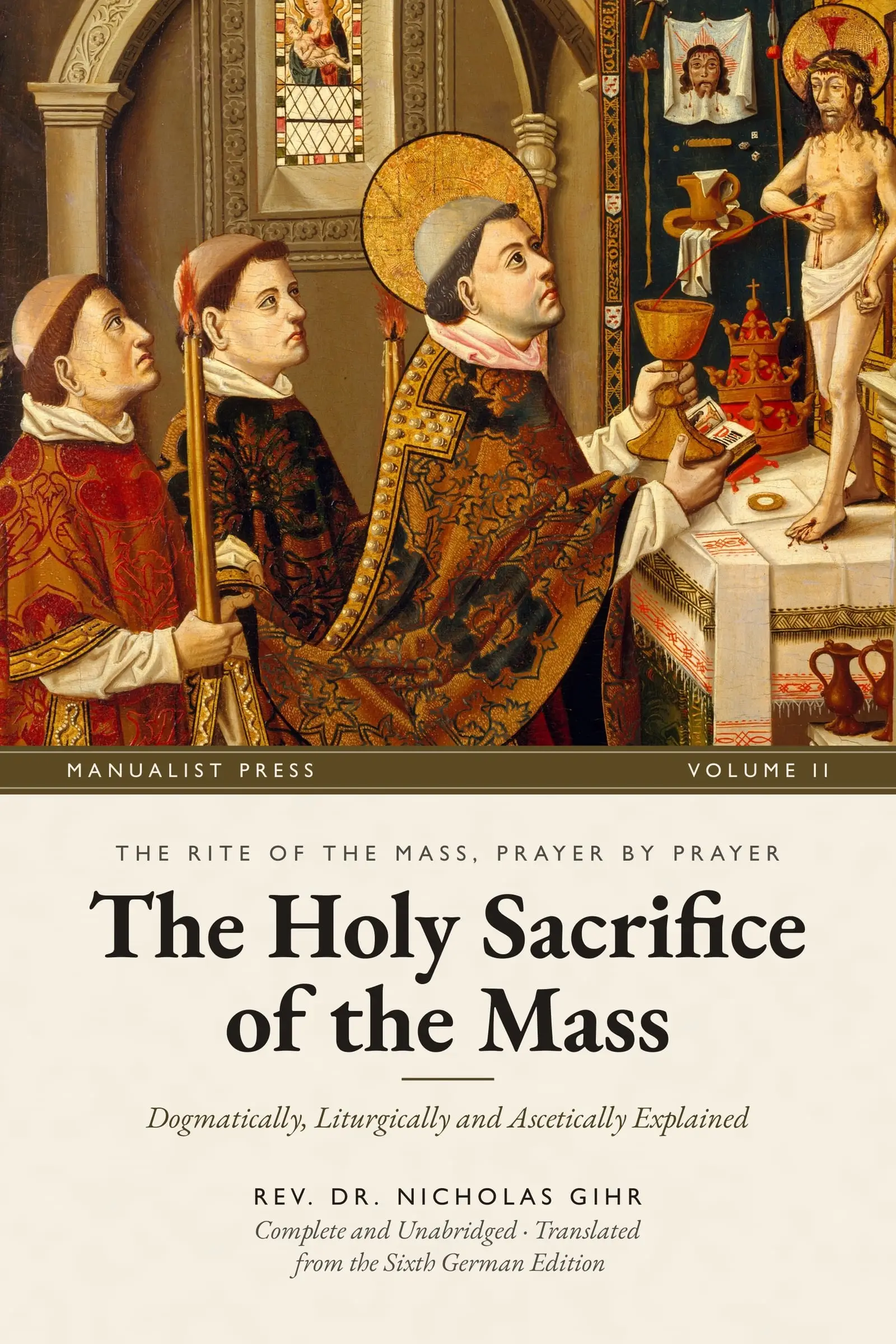
- Master of the First Prayerbook of Maximilian, The Mass of St. Gregory, Hours of Queen Isabella the Catholic, about 1500. Cleveland Museum of Art.
Set from the 1902 English translation of the sixth German edition, published by B. Herder, Freiburg im Breisgau and St. Louis.
The Kindle edition contains Volumes I and II together in one file; the paperback and hardcover editions are issued per volume.
Thank you.
Report a mistake
Manualist Press is a small family press. If these pages help you pray, you can support the work.
