Persuaded by motives drawn from reason itself and instructed by personal experience, St. Ignatius was convinced that the particular examen is as a help to p. 229perfection, the first and surest of all means. So important did he esteem it that he did not hesitate to assign to it a decided superiority even over meditation itself. The reason is, that the examen should in some manner exercise a supervision over the accomplishment of the resolutions formed during the morning meditation. A reflection on the utility of this exercise therefore will incite us to a faithful practice of it. Later on we shall study the proper method to be observed in making it in order that it may be more profitable to us.
Article I
Of the utility of the particular examen
It aids us efficaciously: 1. to correct our vices.
This exercise has for its end the extirpation of some particular vice or the acquisition of some particular virtue. We may judge of its importance in the work of our perfection by the extraordinary eulogiums bestowed on it by the saints.
So persuaded were St. Basil, St. Anthony, and St. Augustine that it includes the inestimable secret of the spiritual life, that they have expressly recommended it to their disciples in their rules.
At a later period, Cassian, St. Dorotheus, St. Bonaventure, and St. Bernard recommended it in like manner and transmitted it as a most precious heirloom to their religious children. But St. Ignatius of Loyola especially desired that this exercise should form, as it were, the chief occupation of the members of his Society, and it is through their ministry that he has contributed to establish the practice of it throughout almost the entire globe.
What occurred to Giezi, the disciple of the Prophet p. 230Eliseus, is a type of the spiritual advantages to be derived from the particular examen. The King of Syria had sent emissaries to surprise and carry off the Prophet. Giezi, says the Scripture, ‘rising early, saw an army round the city, and horses and chariots.’114 Kings vi. 15. Let us represent to ourselves that we are the object of a similar attack, that a multitude of vices surround us, close upon us, furiously pursue us, and quickly reduce us to extremity. But, let us ‘fear not,’22Ibid. vi. 16. if we are provided with the spiritual arms of the particular examen: it is ‘the helmet of salvation,’33Isaias lix. 17. ‘the shield of the strong,’44Nahum ii. 3. ‘the sword of the Lord;’55Judges vii. 20. with it we shall repulse the darts of our enemies, we shall triumph over their assaults, and by a victory more glorious than that of Gedeon exterminate those haughty Madianites. ‘The field of the slothful man filled with nettles, the vineyard of the foolish man covered with thorns,’ are, alas! but too striking illustrations of the state of our soul; for it is as a thicket covered with as many briars as there are evil tendencies springing up within it. But we must take courage and not allow ourselves to be dismayed by these obstacles. If by the aid of the examen we eradicate all these pernicious plants our heart shall soon become as ‘a garden of delights,’66Joel ii. 3. ‘watered incessantly,’77Jerem. xxxi. 12. ‘as a paradise of pomegranates,’ and through which the Almighty ‘will diffuse’ the sweetest ‘perfumes’88Cant. iv. 13, 16. of virtue.
If we groan beneath the weight of an evil habit which encompasses us as ‘a great chain,’99Apoc. xx. 1. and has become a second nature to us; if we are compelled to cry out with the Apostle, Oh, doleful slavery of my captive will! Alas! ‘I do not that good which I will, but the evil which I hate, that I do,’1010Rom. vii. 15. still, provided we be faithful in a daily scrutiny of the state of our conscience, we need entertain no apprehension, ‘we shall as easily break these cords’ and fetters ‘as Sampson broke the bands that bound him, or as tow breaks at the approach of fire.’1111Judges xvi. 9. Though our predominant passion seek to exercise its tyrannic power over us; though, like ‘the great high statue’ erected by Nabuchodonosor, ‘the look whereof was terrible,’1212Dan. ii. 31. it endeavour to affright us; though like ‘a great strong tree,’ it extend its gigantic branches ‘in the midst’1313Ibid. iv. 8. of our heart; though it insult and defy us with the insolence of Goliath, still we shall not be vanquished, provided we constantly recur to the particular examen. This exercise shall be the little stone detached from the mountain which shall break this colossal statue, the axe which shall cut down this mighty tree, the victorious sling which shall overthrow the haughty giant. Yes; our victory is certain, provided we each day carefully perform this salutary exercise. It is a powerful means of success in the spiritual warfare: by it, we separate the forces of the enemy, the more easily to overwhelm and destroy them, while on the contrary we concentrate and augment our own.
There are no vices so heinous, so dangerous, or so inveterate that we may not destroy them by this means, and with the less difficulty in that we attack them separately. The striking analogy that exists between the physical and moral order furnishes us even in the history of profane wars with myriad comparisons illustrative of this truth. Alexander the Great, seeing himself arrested with his victorious troops on the banks of p. 231the Euphrates, and unable for want of boats to cross this wide and rapid river, divides it into several canals and thus easily surmounts the trifling difficulties presented by each. By a similar stratagem, a man who is incapable of breaking several rods which are bound together, detaches and separates them, and no longer experiences any trouble in breaking them severally. The resistance presented by collective forces yields the moment they are divided.
The same rule justly applies here. In combating our defects one after the other we divest them of the great power they possessed of injuring us, and our soul, less restricted in its action, is inflamed with a noble and heroic ardour to pursue them unrelentingly.
In the time allotted each day to the examination, our understanding points out to us but one special vice to be avoided: this vice it accuses, reprehends, and condemns. It considers and beholds only the hideousness, malice, grievousness, and pernicious effects of this single vice, while it only admires, applauds, and counsels the practice of the opposite virtue. It diffuses such vivid light on our will, it urges it with such pious importunity, that the latter at length cedes to it the victory and resolves to shun that particular vice, to eradicate that bad habit which the understanding incessantly represents to it as an object of loathing.
Truth snatches from our favourite vice the mask which invested it with the semblance of virtue, reason despoils it of the hypocritical mantle beneath which it hid itself. Thus displayed in all its native deformity, it inspires us with a salutary horror; the deadly poison which was insinuating itself into our heart loses its activity, its influence diminishes insensibly, and all the strength lost p. 232by this dangerous enemy is so much force gained for the spiritual warfare.
But if under pretence of accumulating our triumphs we engage our soul, which is naturally weak and frail, in several battles at a time, it will obey reluctantly and with a disheartening diffidence of success. We must confine ourselves, therefore, to proposing to it the practice of one particular virtue, in which case, stimulated by the easiness of the task, it will joyfully and confidently devote itself to its accomplishment, and with a holy audacity overcome all the opposition raised by the contrary vice.
It is evident, then, that the particular examen is so much the more potent in the correction of our faults as it augments our strength by weakening that of our adversary.
2. It enables us to acquire virtue
Not only is this exercise beneficial for the correction of our bad habits, but it likewise assists the soul to attain all virtue.
In effect, the particular examen is a daily application of our understanding to persuade and inspire our will to good. Solicited thus each day to aim at and attach itself to the object which is proposed to it as most deserving of its love and ambition, our will, yielding at length to such reiterated entreaties, gives itself up zealously to the practice of good. Perseverance in this duty invariably conducts to solid virtue and sometimes to eminent sanctity, which thus becomes the fruit of the particular examen.
Another advantage of this exercise is that it leads us to a true knowledge of God and of ourselves. It gives us a clear and intimate insight into our own inherent weakness and infirmity and the infinite goodness and mercy of God. Now this twofold knowledge is the basis of the whole spiritual life, and the foundation of our perfection; and it is by the examen, as we have just seen, that we secure it.
Taking it for granted that we are firmly resolved to undertake the great work of our salvation and to give ourselves no respite, till, like Saul, ‘we are changed into other men,’14141 Kings x. 6. we must, according to the advice of the saints, make in the morning a resolution to apply ourselves during the day to fight strenuously against such a vice in particular, and to perform acts of the contrary virtue; we place our good purposes under the protection of the saints, we seal them in communion with the Blood of Jesus Christ, we take heaven to witness our engagement, and consent to experience its justice should we transgress them.
If in examining our conscience at mid-day we find we have forgotten our positive promise of fulfilling or avoiding such or such a fault, of fulfilling such a duty in particular, we immediately make an act of contrition, renew our promise, and resolve with all the fervour of our soul to observe it at least during the remainder of the day. It often happens, it is true, that reappearing in the evening before the tribunal of conscience we again find, notwithstanding the strength of our resolutions, the same faults against which we had so strongly armed ourselves.
But is not this proof of our weakness, frailty, and inconstancy obtained by the mid-day and evening examen a great advantage in itself? By discovering such p. 233numerous faults in detail, and comparing them with those of the previous day, we cannot fail to be filled with confusion, and to cry out in our grief: ‘O God! who so ardently desirest that I should be a saint; but a few minutes since, “I resolved and swore to keep Thy justifications,”1515Ps. cxviii. 6. and in these brief moments “I have” repeatedly “forgotten the holy resolutions I proposed to myself.” I have imitated Peter, who thrice on the same night denied his Divine Master, whom he had just promised to follow “to prison and to death.”1616Luke xxii. 33. My will “changeth as the moon,”1717Eccli. xxvii. 12. “it cometh forth like the flower” in the morning, is then destroyed “and fleeth as a shadow,”’1818Job xiv. 2. changing perpetually.
What a practical knowledge of ourselves such an avowal indicates, and how faithfully the examen, like a polished mirror, reflects the genuine expression of our impotency and nothingness! This salutary exercise likewise teaches us to adore the ‘riches of the goodness,’1919Rom. ii. 4. mercy, love, and patience of God. We there recognise His infinite clemency which dissimulates our numberless offences; which never wearies, notwithstanding our reiterated sins; which, far from condemning or rejecting us, indulgently bears with us, recalls us from our wanderings, raises us from our falls, receives us as His children, and clasping us lovingly to His paternal bosom, restores us to life and vigour.
From this knowledge of God and ourselves, as from an exhaustless source whose principle is in heaven, flow on the one side copious streams of the vivifying waters of profound humility of heart, perfect distrust of our own strength, an intimate conviction of our instability in p. 234good and utter self-contempt; on the other, a boundless confidence in God, based on the consideration of His goodness, whose tender solicitude elevates our soul, fortifies our hope, and consolingly reminds us that ‘those who hope in the Lord shall renew their strength, they shall take wings as eagles, they shall run’ to the goal of perfection, ‘and not be weary, they shall walk’ in the path of virtue ‘and not faint.’2020Isaias xl. 31.
By the practice of the particular examen we may also acquire in a short time the inestimable gift of purity of heart, reckoned by Jesus Christ amongst the beatitudes, ‘Blessed are the clean of heart, for they shall see God.’2121Matt. v. 8. Now, what myriad blessings do we not receive with purity of heart? A pure soul is ‘a spotless mirror,’2222Wisd. vii. 26. wherein all the rays of grace concentrate; an invariably calm ‘sea, of glass, like to crystal,’2323Apoc. iv. 6. ‘a pearl of great price,’2424Matt. xiii. 45. with which we purchase the ‘kingdom of God,’ which consists in ‘justice and peace and joy in the Holy Ghost.’2525Rom. xiv. 17. In a word, the pure of heart are those ‘blessed ones, who alone’ by a glorious privilege are invited to the ‘nuptials of the Lamb,’2626Apoc. xix. 9. and who alone also ‘follow Him whithersoever He goeth, for they are without spot before the throne of God.’2727Ibid. xiv. 4, 5.
Lastly, this exercise is, by excellence, the abridged means of gaining perfection; for all the virtues being, as it were, sisters, and consequently inseparable, by contracting the habit of one we obtain them all. The work of our perfection is a chain formed of several links, one of which being taken in the hand, we may draw the whole towards us. This weapon of the particular examen, directing all its attacks against one particular defect, is a ‘two-edged sword,’2828Apoc. i. 16. ‘reaching unto the division of the soul and the spirit of the joints also and the marrow,’2929Heb. iv. 12. which extirpates even the finest and innermost filaments of our bad habits. It is likewise a most precious gift of God, since it is the most effectual means of eradicating our vices. But you will say: ‘Why combat only one of my vices? I will attack and destroy them all simultaneously and without delay, they shall all perish together beneath my hand.’ Rash words! Are you, then, ignorant that the advice addressed by Moses to Israel is also applicable to us? ‘Thou wilt not be able to destroy thy enemies altogether, but by little and little, and by degrees;’3030Deut. vii. 22. ‘thou art not able to withstand or fight against them,’31311 Kings xvii. 33. ‘because these nations are greater and stronger than thou.’3232Deut. xi. 23. So it is with our spiritual enemies; never can we vanquish or even combat them so long as we leave them united. Unless we have the prudence to separate their forces, never shall we be victorious over them; and after long and fruitless efforts we will be compelled to exclaim with the disciples: ‘we have laboured all night and have taken nothing.’3333Luke v. 5.
Yes, O my God! Thou who beholdest my heart, I am firmly resolved for the remainder of my life to employ each day so easy and efficacious a method for acquiring perfection. The particular examen shall be ‘the preservative of my fervour, my protector against the noonday devil,’ and my guarantee against my infidelities; it ‘shall be a lamp to my eyes,’ the healing balm that ‘bestoweth health, life, and blessing’3434Eccli. xxxiv. 19.—the health of the soul, the life of grace, and the benediction of glory.
Article II
Of the practice of the particular examen
1. The Matter
The particular examen must be made with order, and according to the wants of our soul.
1. Our first care should be to study our principal defect, that which is the origin and source of our other vices, and the root whence they derive their nutriment; that consequently which inflicts most damage on our soul, opposes the greatest obstacle to our perfection, lays snares for us which are so much the more to be dreaded in that they are occult, and which, in fine, leads us to the most proximate danger of mortal sin by smoothing the way to it.
2. However, should we not be under the dominion of any passion, or tyrannized over by any bad habit, we should examine with what fidelity we perform our spiritual exercises, such as meditation, lecture, examen of conscience; what guard we keep over the senses; how often in the day and with what fervour we visit the Blessed Sacrament; what is our love and reverence for the adorable mysteries of our religion; whether we do not approach them with tepidity; what are our most habitual temptations; what the purity of intention with which we perform our ordinary actions; whether we do not allow ourselves to be too much engrossed by exterior things, so as to be but seldom interiorly recollected and still more rarely united to God.
3. When we have completely corrected all that is faulty in these points, we must commence to apply ourselves to the practice of the virtue in which we are most deficient and of which we believe ourselves to stand in need. Following the example of Jeremias, who was appointed not merely to ‘root up and pull down and to waste and destroy, but also to build and to plant,’3535Jerem. i. 10. we must not only eradicate our sinful passions, but we must likewise assiduously cultivate the virtues of humility, charity, and purity, as flowers most charming in the eyes of the heavenly Bridegroom.
For the rest, this application to the practice of virtue is in itself a pleasing and efficacious remedy against our vices. It is towards the destruction of some special defect or the acquisition of some particular virtue, therefore, that our examen should always tend.
2. Important advice concerning the examen
Let us attack before all our other defects that which is most displeasing to our neighbour and is likely to be most prejudicial to him or be to him an occasion of sin. In failing in charity we rarely fall alone; we generally drag others with us: consequently, it is of the greatest importance to direct our first efforts against such a vice.
2. Nevertheless, we must not occupy ourselves solely with our exterior faults and devote all the time of the examen to this object; for since ‘all the glory of the king’s daughter’—that is to say, of the soul—‘is within,’3636Ps. xliv. 14. it follows as a matter of course that we should also pay great attention to what concerns our interior movements in order to render them subservient to the principles of virtue and to quell the revolt of our evil desires. These being once well regulated, we shall no longer manifest these inequalities of temper and conduct so painful to our neighbour, but shall acquire habits of meekness, kindness, and unalterable charity.
3. We often derive only an indifferent advantage from the examen, on account of not knowing where precisely to apply the remedy to the evil which requires to be cured. We must, like a skilful physician, study the source of our spiritual malady and then direct our concentrated efforts against it alone, sparing neither pains nor fatigue in subduing it. For if we cut off the strongest branches of a tree without hewing down the stem, the trunk, divested of the old boughs, will push up new shoots whose destructive shade, owing to the more abundant supply of sap, will extend still farther. Let us then unsparingly apply the axe to the very root of the bad tree, and its branches, deprived of their nutriment, shall wither and die; let us tear the cockle from the field of our heart and it shall perish, nor shall its seed mix with the good grain. The King of Syria being about to give battle to Achab, ‘commanded the captains of his cavalry, saying: “Fight not with the small or great, but with the King of Israel only.”’37372 Paralip. xviii. 30. He was convinced that the loss of the head would inevitably lead to the defeat of the remainder of the army. Imitating the prudent behaviour of this prince, let us destroy our predominant defect, and we will achieve an easy victory over our other vices, whose ruin will complete our triumph.
An able commander exercises special vigilance in guarding the weakest point of a place intrusted to him from an invading foe: let us with equal foresight defend the weakest part of our soul; let us examine what bad habit has struck the deepest roots in our soul, what passion exercises most tyranny over us, and is therefore most to be dreaded; and having recognised it, let us unite all our forces to give battle to this enemy alone.
4. I say this sole enemy, because it is essential to make the examen on only one subject at a time. The collection of the sun’s rays on the focus of a mirror intensifies their heat and increases the fervency with which they consume the inflammable materials exposed to their action. So it is that in concentrating all the energies of our soul against one single defect we insure to ourselves a prompt and complete victory over it. It is even advisable to divide the vice we are fighting against and not attempt the correction of all its ramifications at the same time. The forces of our adversary shall thus be more enfeebled, and we shall more easily attain the end of our designs.
5. We must not lightly change the subject of our particular examen. Many derive but little profit from this exercise because they pass with inconstancy and levity from one object to another, they attack their principal enemy only by impulses and not with serious and persevering efforts: they weary of these fruitless attempts, and finally relinquish the pursuit of a success which they know not how to obtain. ‘They are always studying and never attaining to the knowledge of the truth.’38382 Tim. iii. 7. They are always armed yet never win a victory. It is in this especially that we must persevere, that we must fortify our heart against the vicissitudes of war. Should we be defeated and cast down, starting to our feet once more, we must return to the charge with more courage than before, saying with the Royal Prophet: ‘I will pursue my enemies and overtake them; I will not turn again till I have destroyed them.’3939Ps. xvii. 38. No, we must grant no truce to our adversary nor allow ourselves any repose till we have so weakened this furious hydra, as to be able, without an effort, and by a mere act of volition, to overthrow it again the moment it presumes to lift its head.
We must not be surprised, however, if we very rarely, if ever, succeed in completely conquering our defects: they are monsters which revive from their own ashes, and which we are unable to annihilate of ourselves. All that is required of us, therefore, is to repress and reduce them to an inability to injure us in the perfect discharge of our obligations. This is the extent of the victory we are bound to gain over them.
It is sometimes well, according to the circumstances and dispositions of our soul, to interrupt the principal matter of our examen for a short time, and replace it by another, lest we fall into discouragement; but solely on the condition of resuming the first subject at the end of some weeks, when we have sufficiently recruited our strength to renew the war against our enemy with greater vigour.
6. In order the more speedily to overthrow the strongest rampart of our predominant passion, we must attack it unrelentingly with the arms of prayer and mortification. ‘Labour,’ says Cassian, ‘to overcome the defect against which you have declared war by the austerity of your fasts: let your sighs, vigils, meditations, continual prayers and tears, ascend incessantly to God, begging of Him the grace to conquer it.’
But it is not sufficient that we reflect on the motives that exist for combating such a vice in particular, during meditation and spiritual reading: our heart should frequently reiterate its supplications to God during the day, saying fervently: ‘Lord, grant me chastity, grant me obedience, grant me charity.’ We must also address our humble petitions to our Lord in the Blessed Sacrament, earnestly imploring of Him the needful grace. Lastly, to ensure the grant of our petition, let us beg the intercession of the saints, but above all that of our Immaculate Mother, whom we should honour with a special devotion: for without their aid our labours would in all probability prove futile and unavailing. A modest self-distrust should accompany our prayers if we would have them pierce the clouds, ascend to heaven, and deserve to be offered by our angel guardian ‘in a golden censer on the golden altar which is before the throne of God.’4040Apoc. viii. 3. ‘They that trust in their own strength and glory in the multitude of their riches,’4141Ps. xlviii. 7. are the victims of a cruel illusion. We must likewise unite corporal mortifications, such as fasts, disciplines, hair-cloth, and other similar practices, to our supplications. This will insure their efficacy, as Daniel experienced when he merited to hear from the lips of the angel: because, ‘thou didst set thy heart to understand, to afflict thyself in the sight of thy God, thy words have been heard.’4242Dan. x. 12.
3. The manner in which we should make the particular examen
We shall end this chapter by the following rules concerning the order to be observed in the examen.
First rule.—We must commence the spiritual warfare by a firm and generous resolution to correct ourselves; for ‘the strength of our resolution shall be the measure of our progress,’ says T. A’Kempis. If it is weak our advancement shall be but slow, we shall drag ourselves p. 239on painfully in the paths of virtue. ‘What!’ adds the ‘Imitation,’ ‘if he who takes the strongest resolutions often relaxes, what shall he do who only forms them from time to time, or makes only weak ones?’4343Imit. b. i. c. 19. Soon his tepid and slothful will shall forget its promises, or even, discouraged by the obstacles, completely renounce them. Let us make our resolution in the morning and renew it again at noon.
We must avoid ever forming any resolution the accomplishment of which should extend to our whole life, as the mere idea of being bound to any practice for a long succession of years might terrify us and make us despair of our amendment: it is sufficient, then, each time we renew our good resolution, to limit the obligation of it to half a day. The brevity of such an engagement will inspire us with courage to persevere with constancy and fervour in the good we have begun. The little fruit drawn by several from the examen is, without doubt, owing to their not attaching sufficient importance to forming only such resolutions as are firm.
Second rule.—We must find means to accomplish our resolutions several times in the day; but for that end it is imperative on us to foster it in our heart, recall it to mind from time to time, discreetly, however, and without anxiety; we must prudently foresee all the opportunities of reducing it to practice, anticipate and avoid the temptations to fail in it, recall to mind the motives which inspired us to make it, and joyfully embrace every occasion that presents itself of practising the virtue opposed to the vice which we are fighting against. If, despite these precautions, it happen that we ‘strike our foot against some stone’4444Ps. xc. 12. and fall, let us gently lay our p. 240hand upon our heart, and, repenting of our fault, renew our engagement of being more faithful henceforward.
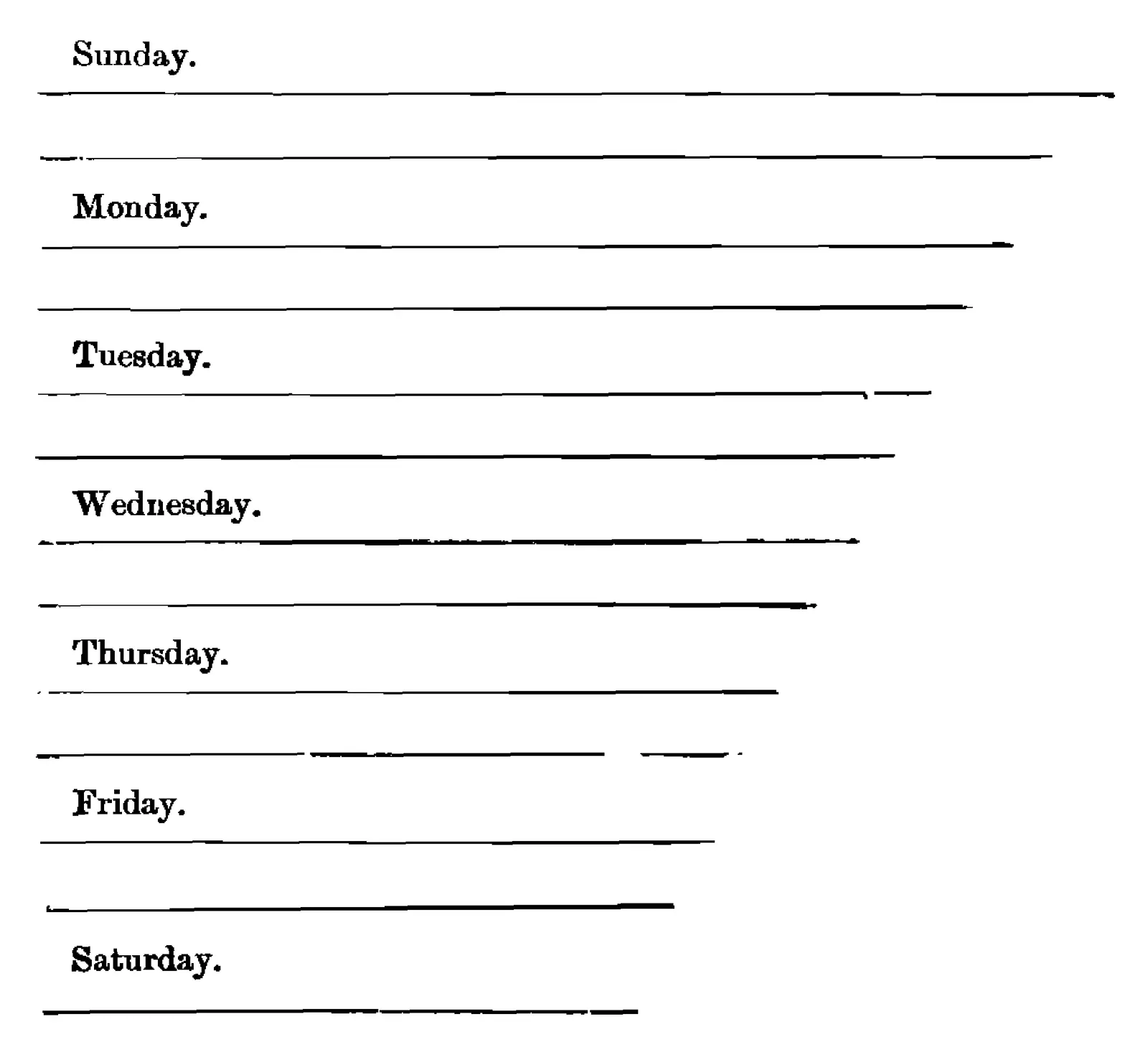
Third and last rule.—We must examine our conscience twice a day, in order to review and carefully scrutinise our actions, to see if we have fulfilled the particular resolution taken at the morning meditation. The examen over, we must excite ourselves to regret for our faults, renew our good purpose of correcting them, and mark, by so many dots on a little book, prepared expressly for this purpose, the number of our infractions. In this way it will be easy for us in the evening to compare the dots we have marked since noon with those of the morning, and in like manner the dots of the present day with those of yesterday, and the dots of the actual week with those of the preceding. This contrast will teach us whether we advance or unfortunately remain stationary in the spiritual life.
What we recommend regarding the particular examen is no new doctrine, it is that of the saints, whose testimony we have already cited, and from whom we have borrowed it. Those illustrious personages have recommended this exercise to their disciples as a sovereign remedy against all the diseases of the soul; they have prescribed it in their rules and bequeathed it as an inestimable inheritance to their spiritual children. How can we refrain from admiring in this the prudence of their zeal? The particular examen is a mute monitor, an assiduous censor of our life, a witness which is constantly beside us, which hourly demands an account of our actions, admonishes us of our obligations, and reprehends us for our faults. It is the precious talent which ‘the master in setting out for a distant country has confided to us,’4545Matt. xxv. 14. charging us to turn p. 241it to account; a talent which will enable us to amass rich treasures of grace and virtue, unless we neglect to trade therewith. It is the probatic well of Jerusalem, wherein not alone ‘he who goes down first after the water is moved, may be cured,’ but whoever purifies himself there at any time, ‘and whatever may be his disease,’4646John v. 3. provided only he be willing to employ this remedy unflinchingly.
Oh! how severe and awful an account shall not he have to render ‘who, like the wild ass’s colt, thinketh himself born free;’4747Job xi. 12. who hearkeneth not to the voice and ‘receiveth not the discipline’4848Soph. iii. 2. of this faithful monitor; who ‘goes to dig a hole in the ground to hide his talent in,’4949Matt. xxv. 18. and leaves it there idle; who, ‘sick for thirty-eight years,’5050John iii. 5. remains seated at the source of salvation, ever the victim of the same infirmity, because he foolishly neglects to recur to so infallible and easy a means of cure!
Unhappy we! one day countless bankers and merchants, now engaged in advancing their fortune, shall arise from the east and the west and from the most remote regions; they shall arise, I say, with their account-books, to which their daily losses and gains are consigned with the strictest exactitude, and shall condemn our indifference regarding our spiritual traffic.
Many of the saints shall also arise, holding in their hands the faithful journal of their examen, the practice of which has conducted them to so high a degree of sanctity and glory; they shall arise and overwhelm us with shame for our sloth in acquitting ourselves of this duty.
The demon himself shall arise, and displaying before us so many reams of paper covered by us during life with useless writing, shall reproach us with not having dedicated one sheet to so all-important a duty as our examen: thus shall he confound our indolence.
Alas! what shall be our humiliation when we see that those merchants have done more for a little money than we have done for God? That we have wasted so much paper in worthless writing, without having consecrated one page to the noting down of our faults? That our friends, our penitents, our pupils, have attained to such perfection, conquered such vices, acquired such virtues by means of this exercise? When we perceive that we might have easily reaped the same benefits from it; that we had the means in our hands; that nothing prevented, whilst everything co-operated thereto; that we were wont to exhort others to make it; and yet, oh, the folly! we have neglected it ourselves, we have even regarded it with contempt as a childish pastime, all very well for novices! What shall be our shame when we have to admit that, after several years spent in religion, we have not corrected one fault or acquired one virtue by the aid of this holy practice? that our hair has blanched, we have reached the term of life, as imperfect, nay, perhaps, more vicious than we were in our youth? What esteem shall we set on the examen? What remorse shall we not experience for having forgotten it? Let us now, therefore, faithfully accomplish an exercise, the omission of which later on must cost us such remorse, whilst the fulfilment of it will be fraught with consolation.
O illustrious St. Ignatius! enlightened master in the ways of perfection, may thy voice resound in my ears. From the sublime throne of glory, which thou dost occupy, imprint indelibly on my heart these words of Solomon: ‘My child, “keep my rule” of the particular examen “as the apple of thine eye: bind it upon thy p. 242fingers; write it on the tables of thy heart, and thou shalt live.”’5151Prov. vii. 2.
Yes, great Saint, it shall be so. ‘I will put’ the instructions thou hast given me, concerning this holy exercise, ‘around my neck; they shall accompany me when I walk, they shall be with me when I sleep, and I shall converse with them when I walk, because thy commandment is a lamp and a bright light, which’ directs us in the path of virtue, and ‘thy doctrine is the way of life.’5252Prov. vi. 23.
Henceforth, therefore, ‘may that day perish’ on which I shall omit the particular examen; ‘let it not be counted in the days of the year, let it be wrapped in bitterness, and let a darksome whirlwind seize upon that night,’5353Job iii. 3 and fol. at the commencement of which I shall deem the noting down of my faults as a thing of trivial consequence; ‘let not the light shine’ upon the week which I shall have neglected to compare with the preceding one, and let the month in which I have been guilty of a similar omission ‘be covered with darkness, and with the shadow of death.’ Yes, my resolution is taken: never again will I allow a single day to pass without marking down my faults. I will imitate the geometrician, who, by the aid of a number of points, contrives to find the centre whence proceeds the radius ending at the circumference of the circle, the symbol of a happy eternity.54
(Note of French translator.) The following is St. Ignatius’ method of making the particular examen: He desires that the moment we get up in the morning we recall to mind the vice or defect we propose to combat during the day. At noon we examine how often we have fallen into this defect since morning, and mark the number of falls by a corresponding number of dots on the first line conformable to that of the model here given. In the evening we make a similar survey of our conscience for the second part of the day, and mark the number of failings on a second line, in order to compare both lines, and see whether we have made any spiritual progress. We continue to compare the examens of the second day with those of the first, and the examens of one week with those of the preceding. In the subjoined figure the length of the lines diminishes daily, because it is obvious that the number of our faults should go on diminishing daily. (Taken from the Book of the Exercises, particular examen.)