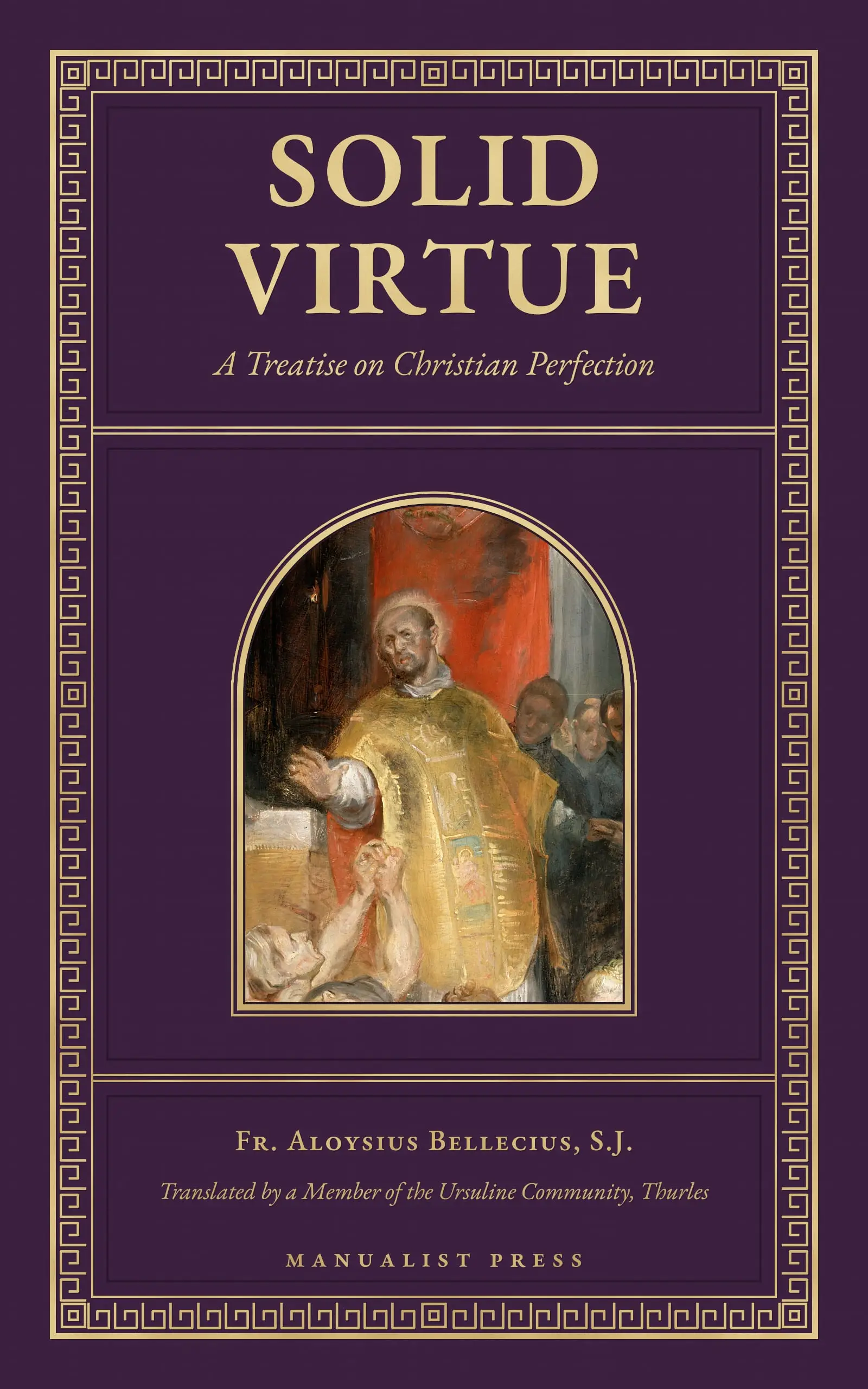
Solid Virtue
A Treatise on Christian Perfection
Father Aloysius Bellécius, S.J., 1914
Fr. Aloysius Bellecius, S.J., wrote Solid Virtue for people who had already given their lives to God and were still confessing the same faults every week. He calls the condition tepidity, and he warns that the tepid man rarely recognizes himself. He softens nothing.
The first part names six habits that keep a person lukewarm: venial sin excused as small, tepidity itself, resisting grace, the one passion that feeds the rest, the fear of what people will say, and lying in bed after you have woken. The second part gives six practices for getting out, with detail you can act on the same day. Fix tomorrow’s rising hour before you sleep. Read a quarter hour a day and finish the book you start. Keep the particular examen St. Ignatius taught, a little notebook of dots for counting one fault at noon and again at night. Make a retreat of three days twice a year. The third part is the long argument for keeping it up, ending with final perseverance.
Nearly every chapter closes with an examination of yourself, and a Double Table at the front arranges the book as two retreats of three days. Bellecius wrote with his fellow Jesuits in mind and says so. Archbishop Croke, who introduced the English translation, insisted it was for lay people as much as for the cloister, since there were no two Gospels given to the world. He defined devotion as the love of God reduced to a settled everyday practice, which is a fair summary of what this book is for.
The first page of Of Venial Sin

Chapter I
Of Venial Sin
Mortal sin extinguishes charity, banishes the Holy Ghost, withdraws us from our last end which is God, inflicts death on the soul, closes heaven against it, and leads straight to hell.
There can be no question, then, of reckoning this monstrous evil, the very mention of which fills the friends of God with horror and dismay, amongst the obstacles to our progress in virtue. We shall not allude to it here.
Venial sin, according to the Doctors of the Church, is the first obstacle to our perfection. To learn how to avoid it, and to stimulate ourselves to do so, let us reflect that it is a great evil—1st, in itself; 2nd, in its effects; and 3rd, in the chastisement it involves.
We will conclude this chapter by examining whether we entertain a genuine hatred of venial sin and a firm resolution to fly even the least faults.
Contents
Related Books
Check your inbox
Confirm from the email we sent before any prayers arrive.
Edition & sources
Edition
- Translator
- Abbé Berthon
- Translator
- A member of the Ursuline Community, Thurles
- Introduction
- Archbishop Thomas William Croke
- Source edition
- A Treatise on the Obstacles to Solid Virtue, the Means of Acquiring, and Motives for Practising It, R. & T. Washbourne, Ltd., with Benziger Brothers, 1914
- This edition
- Manualist Press, July 2026
- Paperback
- 450 pages, ASIN B0H9BTF5S7
- Hardcover
- 450 pages, ASIN B0H9BWQFKD
- Kindle
- 427 pages, ASIN B0H9B6DG82
- Sample
- Preface, Author’s Preface, Part I. Obstacles to Solid Virtue, Chapter I. Of Venial Sin and Chapter II. Tepidity
- Plate
- Philip Galle, The Seed Finding Good Earth, 1574. Cleveland Museum of Art.
Set from the eighth edition of 1914, published by R. & T. Washbourne, London, with Benziger Brothers, in the English translation by a member of the Ursuline Community, Thurles, with the preface by Archbishop Croke.
Thank you.
Report a mistake
Manualist Press is a small family press. If these pages help you pray, you can support the work.
