Extreme Unction
All persons dangerously ill, or in danger of death from sickness, wounds or accidents, are bound under pain of mortal sin to be anointed, or, in other words, to receive the holy sacrament of Extreme Unction.
Sick-Calls
I. Calling the Priest
Never send a child to call the Priest. Send a grown person. If there is no grown person in the house able to go, ask a neighbor to do so.
The sacraments of the dying are all too important and of too great a dignity, as that the arrangements for their administration should be made through children.
The Blessed Sacrament must not be carried through the streets unnecessarily, as often happens through calls being made by children, from whom the Priest cannot obtain exact information. Neither must the Priest be called out unnecessarily, as so often happens, likewise, through the calls of children who know not what to answer to the inquiries of the Priest.
Catholic neighbors must always be willing to assist one another on occasions of sickness and death.
Do not simply send for the Priest, but let the person who calls, be instructed as to what information he is to give to him.
The messenger should be able to give the following items:
1. Full name of the sick person; the correct address, that is, the name of the road or street, and the exact house-number.
These items are all the more important, if the Priest should not be at home and the call would have to be left in writing.
2. The age or condition of the person, whether child or grown person; whether practical Catholic.
3. Has the sick person been attended to before in the same sickness and by which Priest?
4. Which sacraments have been received and when?
5. Is the person able to receive Holy Communion, that is, is the sick person conscious or not subject to vomiting?
6. Has a physician attended and what is his opinion of the danger?
Whenever there is real danger, notify the Priest at once. Do not wait. Do not wait until evening or night.
Never call at night, on Saturday afternoon or evening, or on Sunday, except in case of sudden sickness, or when danger in delaying is apparent.
Do not call at the above-mentioned times for a sick person who has already been entirely attended to, unless the Priest has left word to that effect, or has not been to see the person for some time; or in case the sick person insists on it of his own accord, evidently from some trouble of mind.
If a sick call is made at night, let a gentleman accompany the Priest to and fro, until the Priest dispenses with his company.
Let no one speak to the Priest on the way, whilst he carries the Blessed Sacrament, except what is strictly necessary, or until he himself begins to speak.
It is not necessary to call the Priest for sick infants, as long as they have been baptized; but it is necessary in the case of children of seven years or even of younger children, if they have attained the use of reason. It may be necessary to give the latter absolution at least, if not to anoint them.
II. Preparation of the Sick Person
The sick person must be forewarned of the Priest’s coming, and must be advised to prepare for confession and the possible reception of the last sacraments.
Only when there is no immediate danger of death, and the Priest is called merely to speak to a sick person under peculiar circumstances, may the latter be left ignorant of the Priest’s intended visit. But the Priest must consent to this arrangement, and not, by being left in ignorance of it, be brought into any embarrassing situation.
Attend to the sick person’s appearance. See that it is clean and neat. Have face, hands and feet washed and the hair put in order.
When Holy Communion is to be administered, see that some preparation by prayer be made. If the sick person is unable to read, it is good for some one to read a few short prayers slowly and devoutly from a prayer-book, if circumstances will permit.
If there is danger of death and the Priest is to administer the last sacraments, or Holy Communion as Viaticum, the sick person need not be fasting, but may take whatever food, drink, or medicine may be necessary.
III. Preparation of the Sick-Room
Have the sick-room in good order by the time the Priest arrives, perfectly clean and tidy. Have all unsightly objects removed, such as soiled linens, dishes and vessels used by the sick person. Let the articles that must remain, be perfectly clean and presentable.
Have clean linens and coverings put on the bed.
Have no dog, cat or other animal in the room or in the parts leading to it.
Have a small table with a clean white cover opposite the sick-bed or at some distance from it, so that it can be seen by the sick person.
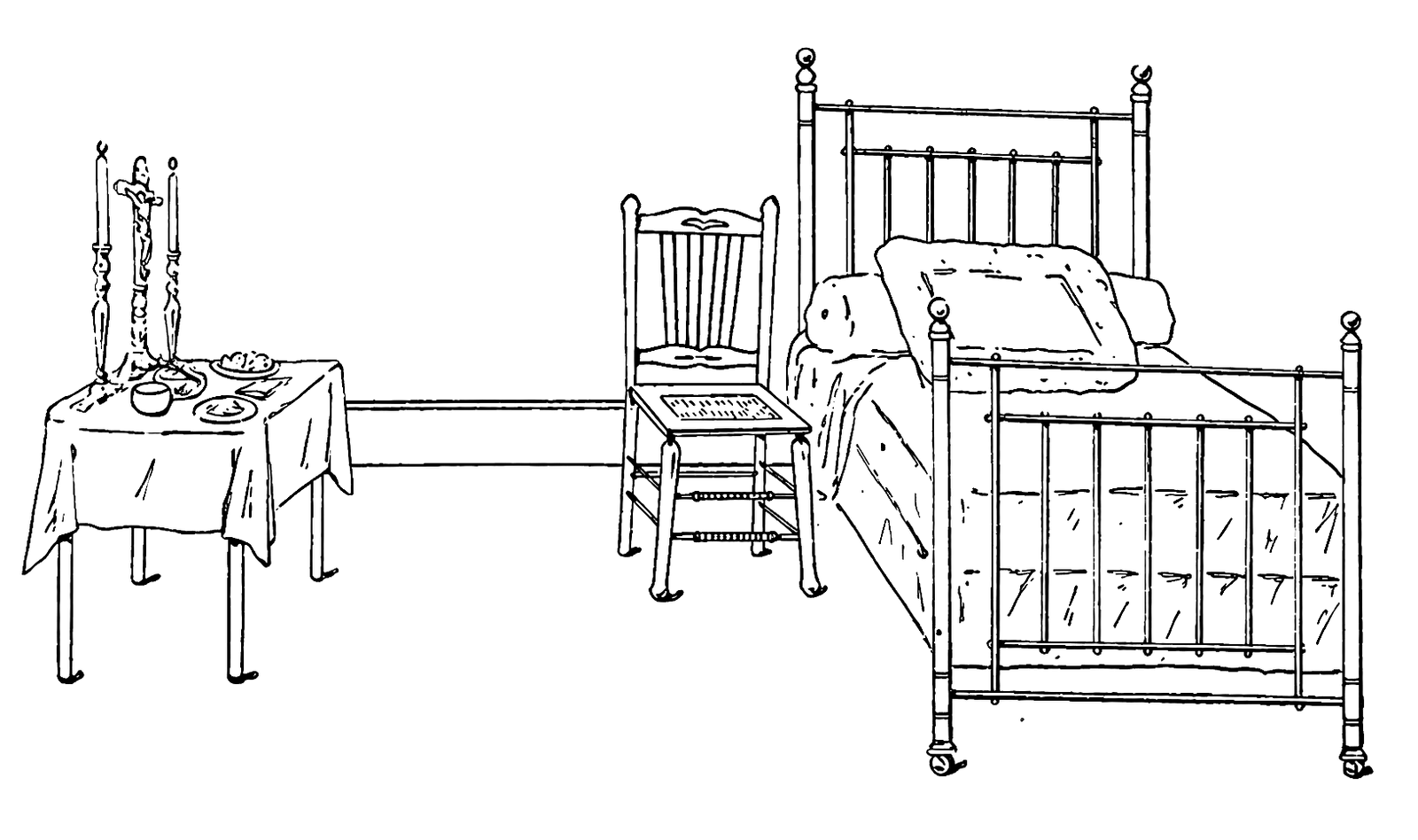
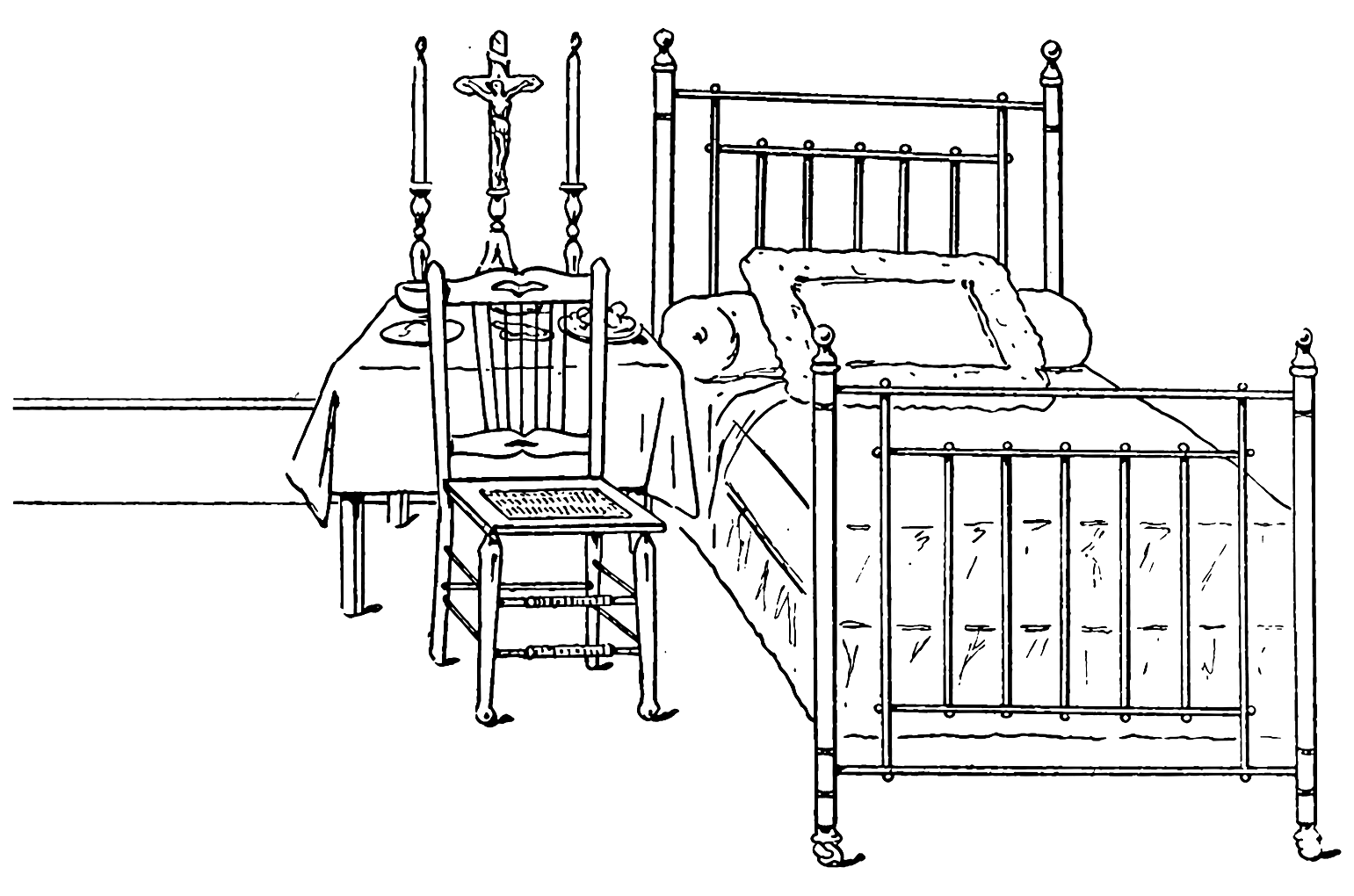
Arrangement of the Sick-Room
Do not place it right next to the bed at the head of it, if it can be avoided.
Have a chair immediately next to the bed at the sick person’s head for the Priest, so that he may look toward the foot of the bed and not into the sick person’s face when he hears the confession.
IV. Articles for the Sick-Room
1. A small table or stand, at least two feet at the top, with a clean white cover.
2. One crucifix standing on the table or hanging directly over it for handing to the sick person to be kissed. Do not have the holy water-font attached to it.
3. Two pure wax candles, or one at least, in suitable candlesticks.
4. One small vase or glass of holy water (not Easter water) with a small sprig or brush for sprinkling.
5. One small glass of fresh drinking-water and spoon.
6. One clean white cloth, napkin or small towel, as a Communion cloth.
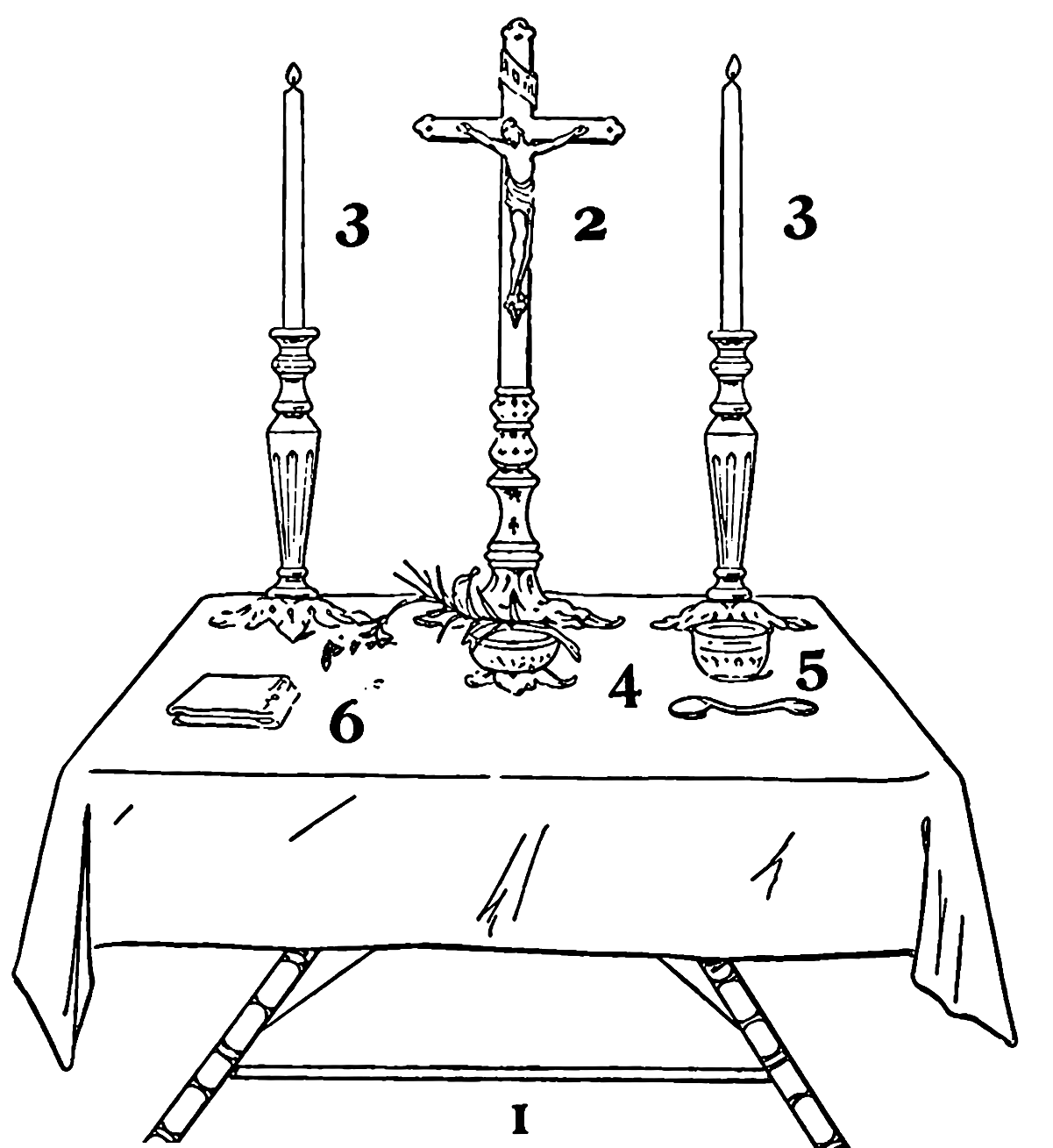
1. Table with white cover.
2. Crucifix.
3. Pure Wax Candle.
4. Vase of Holy Water.
5. Glass of Water and Spoon.
6. White Napkin.
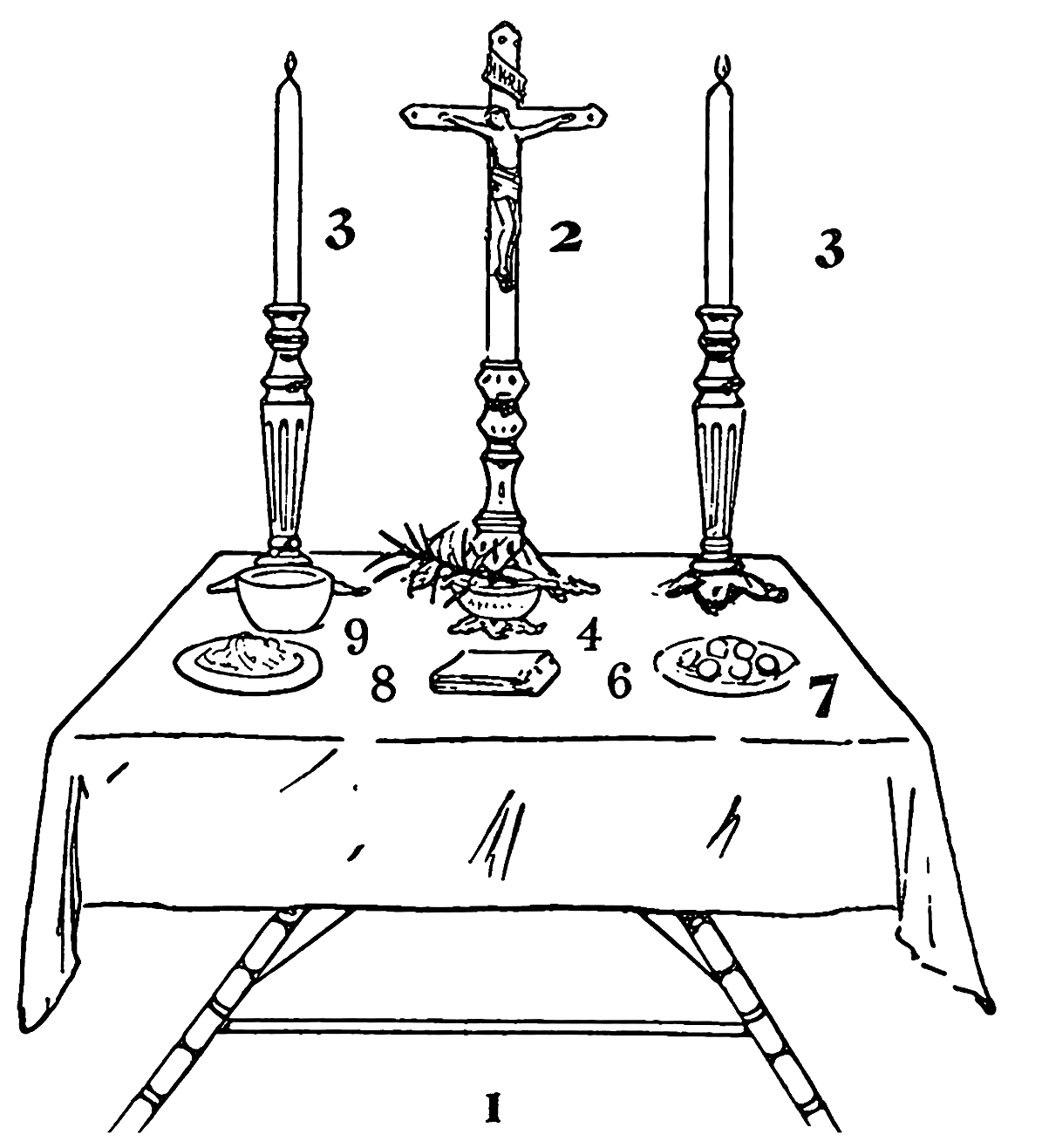
7. Plate with Six Balls of Cotton.
8. Plate with Salt or Crumbs of Bread.
9. Finger-Bowl.
Sick-Room Table
7. In the case of Extreme Unction being administered, also a small plate containing six small balls of white cotton of the size of large plums, and
8. A small plate with salt or small pieces of fresh bread without crust, for the cleansing of the Priest’s fingers after anointing, together with a finger-bowl with water and a towel.
Have nothing else but the above-mentioned articles on the sick-room table. Keep all medicine-bottles, spoons, glasses and other objects not needed for the administration of the sacraments on another table or stand.
V. Administration of the Sacraments
The following rules suppose the bringing of Holy Communion to the sick person.
As soon as the Priest arrives at the house, let someone meet him at the door with a lighted candle, and having bent the knee before the Blessed Sacrament which he carries, lead him to the sick-room.
Let none bid him the time of the day or begin to speak to him, unless what is strictly necessary, and that in a low tone of voice.
Let all others drop on their knees as soon as they meet the Priest, in whatever place they may be, and then follow him to the sick-room.
All should remain kneeling in the sick-room or in the place adjoining it, as space will permit, whilst the Priest pronounces the blessing and sprinkles the room, and not retire until bidden by him, when he is about to hear the confession.
Do not run away when the Priest comes; but let all endeavor to be present when he administers the rites of religion. Arrange your dress and put on a respectable appearance. Let no one be present in his shirt-sleeves, or with bare arms and the like.
When the Priest has heard the confession of the sick person and gives the signal, all should re-enter the room and remain kneeling in devout prayer until the Priest has finished his administrations.
If at any time before the Priest administers Holy Communion, it is necessary to pass before the sick-room table, the knee must be bent before it as in passing before the altar in church.
If anyone is familiar with the Latin prayers, he should answer to them.
Somebody should be ready to assist the Priest, especially during the anointing, to see that the ears, hands and feet of the sick person are uncovered and properly presented for the unctions.
Whatever articles of devotion may be required for the sick-room, have the Priest bless them before he retires, such as an indulgenced crucifix for the sick person to hold, a pair of beads, the scapulars and the like.
VI. After the Administration of the Sacraments
Have a crucifix or picture of the crucifixion, an image of our Blessed Lady, or other devout images placed about the sick-room in view of the sick person, so that he may frequently raise his heart to God at the sight of them.
Sprinkle the sick person occasionally with holy water, especially in his last agony.
Listen attentively to the instructions the Priest may leave, especially as to calling him again. Call him only in accordance with these instructions.
The water, bread, salt, cotton or other matter with which the Priest has purified his fingers, must be thrown into the fire.
VII. Assisting the Dying
As it is not always possible for a Priest to be present at the actual moment of death, especially in large parishes, and more especially where the parish covers a large territory, the faithful should themselves endeavor to assist their dying brethren after the Priest has administered the last Sacraments.
When they see that the patient’s end is approaching, they should light a blessed candle and assist him to hold it in his hand, at least during the regular prayers for the dying and in the actual moment of death. If the agony should last a considerable time, some one else may hold the candle near by and keep it in readiness.
Some one should read the prayers for the dying from the prayer-book as well as other prayers after them, if the death-agony should continue.
If the agony should last very long, those and other prayers may be repeated from time to time.
The person holding the candle or kneeling close to the dying person, should from time to time, and especially at the last moment, repeat short and fervent invocations to him, such as: “My Jesus, mercy.” “My Jesus, forgive me my sins; I am heartily sorry for them.” “Sweet Heart of Mary, be my salvation.” “Jesus, Mary and Joseph, assist me.” “Jesus, Mary and Joseph, into your hands I commend my body and my soul.” “Lord, not my will, but Thine be done.” “Father, into Thy hands I commend my spirit.” “Angel Guardian and my Holy Patron, assist me,” etc., etc.
Sprinkle the dying person often with holy water, especially if he should seem to have a hard struggle.
Let not too many persons crowd into the death-chamber, especially if it is small. If there should be many visitors, let them remain but a short time to say some prayers and then retire.
Do not sit around in the sick-room or adjoining rooms, unless you are sure you will be needed and can be of assistance.
