Matrimony
Remember that marriage with Christians is a sacrament, and needs a careful preparation. Otherwise this sacrament may be received unworthily, and an unhappy life, as is so often the case, may be the consequence.
When marriage has been decided upon, make arrangements as soon as possible with the Pastor.
Do not fix the date and hour yourselves, but consult the Priest and fix the time with him.
Remember, the law of the Church requires marriage-parties to be called out in their parish-church on three consecutive Sundays or holydays. This law is binding under pain of grievous sin. These announcements are called the Bans of Matrimony.
If there is any reason for not being called out three times, or for not being published at all, the reason must be made known to the Bishop.
Such preliminaries of matrimony require time, in order to comply with the laws of the Church, or to obtain the necessary dispensations from them. Hence the necessity of making application to the Pastor at least three weeks in advance of an intended marriage.
If there should be any impediment to the intended marriage from which it may be possible to obtain a dispensation, this must also be made known to the Bishop, together with the reasons for desiring to enter such a marriage.
If the Bishop sees fit to grant a dispensation from the bans of matrimony or from an impediment, the fine or penalty imposed by the Church for the same, must be paid, and whatever conditions may be prescribed must be fulfilled.
Engagements made with those of another religion, or with those with whom the laws of God or of the Church forbid matrimony, are not valid before the Church, and consequently not only do not bind in conscience, but are even sinful.
If the marriage-parties belong to different parishes, their bans of matrimony should be published in each parish.
Anyone aware of an impediment between the parties to be married, is bound in conscience to report the same to the Pastor.
The impediments of matrimony are:—
I. Such as make a marriage null and void. Blood relationship up to the fourth degree or third cousinship. Affinity, or relationship by marriage to the fourth degree or third cousinship of the husband or wife. Spiritual Relationship between Godparents or Sponsors and those for whom they stand at baptism or confirmation, and the parents of the same, as well as between baptized persons and those who baptize them. Public Honesty, forbidding marriage with a parent, child, brother or sister of one with whom a valid engagement to marry had existed. The Crime of Homicide or Adultery on the part of persons, one of whom is married, with a view to subsequent marriage. Difference of Worship, that is, marriage between a baptized and an unbaptized person. Vows on the part of sacred ministers and religious who have pronounced solemn vows. Clandestinity in places where the Decree of the Council of Trent has been published, declaring marriage null and void unless contracted before the Pastor and two witnesses. This decree obtains in the following places in the United States: in the States and Territories of Alabama, Arizona, Arkansas, California, Colorado, in the southern part of Indiana, Indian Territory, Louisiana, Mississippi, Nevada, New Mexico, Texas, Utah, west of the Colorado River; the city of St. Louis, Missouri; the parishes of St. Genevieve, St. Ferdinand and St. Charles, belonging to the Archdiocese of St. Louis; the parishes of Kaskaskia, Cahokia, French Village and Prairie de Rocher, belonging to the Diocese of Alton, Illinois. The Bond of previous marriage, if both parties are still living.
II. Impediments which make a marriage unlawful, but not null and void. Such are, A Simple Vow to observe chastity, to enter the priesthood or the religious state. A Previous Valid Engagement to marry someone. The Forbidden or Closed Time of Advent or Lent, that is, from the first Sunday of Advent until the seventh day of January, and from Ash Wednesday until the second Monday after Easter Sunday. A Mixed Marriage, that is, a marriage with a Christian or baptized person, but who is not a Catholic. The Non-Consent of Parents when their consent is justly withheld.
If the marriage-parties belong to different parishes, they may choose either one of them, as a rule, for the marriage-ceremony. The church of the bride, however, is more usually the one in which the marriage is performed.
After arranging with the Pastor the time for the marriage-ceremony, a time should be appointed also for the marriage-instruction.
The marriage-instruction is all important, that the parties may be advised of the sacred and indissoluble character of matrimony, of the duties of husband and wife towards each other, as well as towards their children, and of the ceremonies that are to be performed in the reception of the sacrament.
It is customary for Catholics before entering the important state of matrimony, to make a general confession of their sins some weeks prior to the event.
Whether this confession is to be made of one’s whole life, or only of a portion of it, will depend upon the decision of the confessor whose advice should be previously asked.
The bridal parties should confess also immediately before marriage, at least the evening before it.
Any doubts as to the obligations of the matrimonial state should be settled in the confessional.
Catholics should bear in mind that the marriage-ceremony is the principal thing about their wedding. All other observances are secondary. Marriage is a sacrament. Hence it would be a shame to curtail the religious part of it, or to avoid the expense or publicity of the same in preference to other bridal observances more popular with people of fashion; such as the bridal outfit, the breakfast, the wedding-tour or the future style of living.
The proper marriage-observance in the Catholic Church is the Bridal or Nuptial Mass. It may be a High Mass or Low Mass, according to local custom or circumstances.
Marriage without a Mass and especially in the evening, is not according to the spirit and intention of the Church, and is against the express wish of the Bishops of this country. The following are their words in the Third Plenary Council of Baltimore:
Let those who have the care of souls, take every occasion earnestly to exhort the faithful to the keeping of that pious and praiseworthy custom of the Church, whereby marriages are celebrated, not in the night-time, but during Mass, and accompanied by the Nuptial Blessing. * * * * This custom is held to be not merely a commendable but quite a necessary one, now in these present days, when the foes of religion are leaving nothing untried in their efforts to deprive, if possible, Holy Matrimony of all sanctity, and of all likeness to a sacrament, and to degrade it to the level of a mere civil contract. (Decrees, N. 125.)
Let them enter into marriage only through worthy and holy motives, with the blessings of religion, especially with the blessing of the Nuptial Mass. (Pastoral Letter, p. 87.)
The Nuptial Blessing can be given only at Mass. It can likewise, be given only once in a lifetime, so important is it; so that if a widow should marry again, she could not receive it, if it had been imparted to her at her first marriage.
A young woman, therefore, who is married in the evening or without a Mass, does not receive this bridal or nuptial blessing. What a shame to deprive oneself of such a blessing, so necessary for future happiness in the married state!
The Marriage-Ceremony
Be on time. Let this be the first observance. The Priest may have other engagements. In places where there is more than one Priest, the celebrant may begin the Mass on time, and arrange with another Priest to marry the bridal couple quietly at the altar-rail during the Mass. A necessary treatment sometimes for late comers. Sometimes it is impossible for the celebrant to wait on account of other masses or services to follow.
Be in church before the Mass to make a preparation by prayer.
Kneel in the front pew or on special kneelers prepared for you, accordingly as it may be the custom.
Remove your gloves before you approach the altar. The marriage takes place immediately before the Mass.
If you go into the sanctuary according to custom, let the Groom walk first with the Bride at his left. Then follows the Groomsman or Best Man, with the Bridesmaid likewise at his left.
Make no genuflection until you reach the steps leading to the altar.
Let the Groomsman then go to the right of the Groom and the Bridesmaid to the left of the Bride and let all four then bend the knee together on the floor of the sanctuary and ascend together to the platform of the altar.
The Groom and Bride kneel on the edge of the platform, not on the upper step, but on the same level with the Priest. The Groomsman and Bridesmaid, however, stand respectively to the right and left of the bridal couple on the upper step or next lower level to the platform.
The following are the questions and answers which occur during the ceremony, with which the bridal couple should make themselves familiar:
PRIEST: (To the Groom.) N. Wilt thou take N. here present for thy lawful wife, according to the rite of our Holy Mother the Church?
GROOM: I will.
PRIEST: (To the Bride.) Wilt thou take N. here present for thy lawful husband according to the rite of our Holy Mother the Church?
BRIDE: I will.
The Bridegroom and Bride then join their right hands, and whilst so doing usually recite the following formula after the Priest, first the Bridegroom and then the Bride.
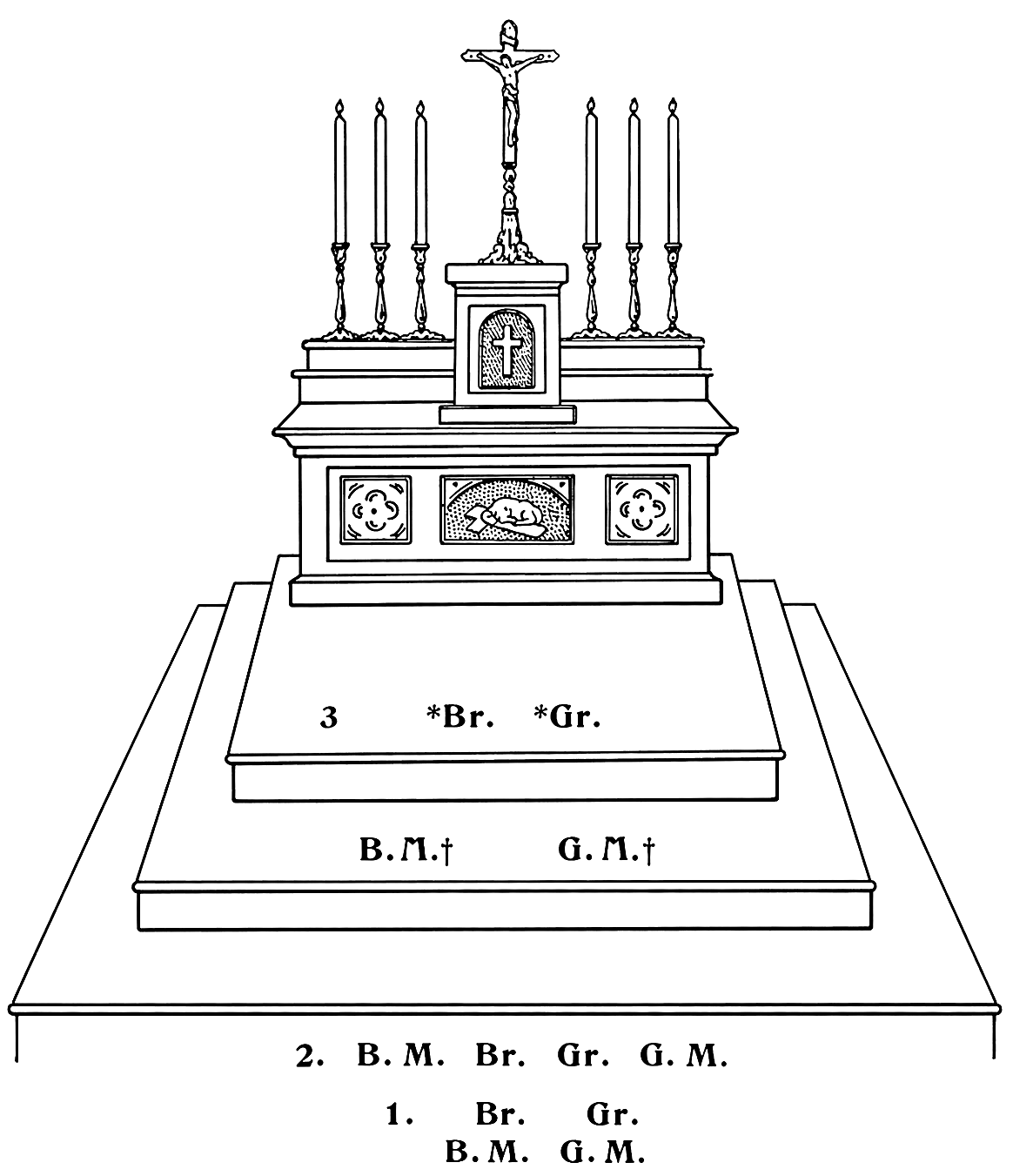
1. Going to the Altar. 2. Genuflecting before the lowest step. 3. Position during the marriage ceremony. * Kneeling. † Standing. Gr., Groom; Br., Bride; G. M., Groomsman; B. M., Bridesmaid.
The Marriage Ceremony
BRIDEGROOM: I, N. N., take thee N. N. for my lawful wife, to have and to hold from this day forward, for better, for worse, for richer, for poorer, in sickness and in health, till death do us part.
BRIDE: I, N. N., take thee N. N. for my lawful husband, to have and to hold from this day forward, for better, for worse, for richer, for poorer, in sickness and in health, till death do us part.
After these words the right hands are still kept joined until the Priest has made the sign of the cross over the bridal couple and has sprinkled them with holy water.
The Bridegroom then produces the ring and places it on the plate for the Priest to bless it.
When the Priest presents the ring to the Bridegroom after the blessing, the latter puts it on the third finger of the Bride’s left hand, saying the following words, if the Priest suggests them:
With this ring I thee wed and plight unto thee my troth.
After a few more prayers by the Priest, the bridal couple rise and with the Groomsman and Bridesmaid go down the steps, turning around completely, make a genuflexion towards the altar on the floor of the sanctuary, and return, the Groom and Bride walking first, to their places.
During the Pater Noster of the Mass, the Groom and Bride only go up to the platform of the altar again, in the same manner as before the Mass, and again kneel immediately behind the Priest on the edge of the platform.
They remain kneeling there whilst the Priest says the prayers over the Bride, and return to their seats again, when he turns to the altar and continues the Mass.
It is customary for the Groom and Bride at least, to receive Holy Communion.
During the last prayers of the Mass, at the epistle side, the Groom and Bride only go up to the altar again and kneel as on the previous occasions, immediately behind the Priest on the platform of the altar.
They remain there attentive to his prayer and to the exhortation he may think proper to give, and do not retire until he has sprinkled them with holy water and has imparted both to them and to the congregation the blessing of the Mass.
They remain in prayer and in thanksgiving at their places some minutes after the Mass, whilst the Priest makes his thanksgiving, and whilst the congregation leaves the church. They should not leave the church immediately after the Mass, especially if they have received Holy Communion.
They should then have their marriage recorded in the parish-register. To have it done before the marriage, so as to expedite matters after the marriage-ceremony, is not the correct thing. It is not a truthful record and is often attended with mistakes and difficulties.
If a license is required by the State, the certificate must be shown to the Priest before the ceremony and signed by him after it.
The marriage-fee, as well as the offering for the Mass, should be paid before the ceremony takes place.
Do not ask for special privileges in your case or for exceptions to the general regulations of the parish or of the Church. This embarrasses the pastor very much. One exception thus made may justify twenty others, and thus the Pastor is hampered in his efforts to have order and to do justice to all his parishioners. If you are prominent in the parish by the active interest you take in its affairs, you may rest assured that you will be honored in more than one way without asking the distinction yourself.
If your prominence in the parish is due only to your wealth or to your popularity outside of the Church, it is not fair to make the Church sacrifice her rules and regulations to privilege you above others, who are perhaps more deserving members of the Church, even though they are poor and unpretending.
Do not mix up worldly, protestant or even heathen observances with the matrimonial customs and ceremonies of your Church. Let no rice be thrown in or near the sacred edifice of the True Temple of God. There is no marriage-ceremony more appropriate, beautiful and edifying, than that of the Catholic Church, when fully carried out according to her rules and privileges. But when her ceremonial is rejected, foolish, un-Catholic practices will be substituted.
Do not ask that the Church be specially decorated for the occasion, or go to expense for the purpose, unless you have been accustomed to decorate or embellish the church on other more sacred occasions. Such conduct is pure vanity and self-adoration.
A bridal tour is preferable to a wedding-banquet carried into all hours of the night, and even into the next morning, with drinking, dancing and boisterous behavior to the disedification and annoyance of all respectable people.
