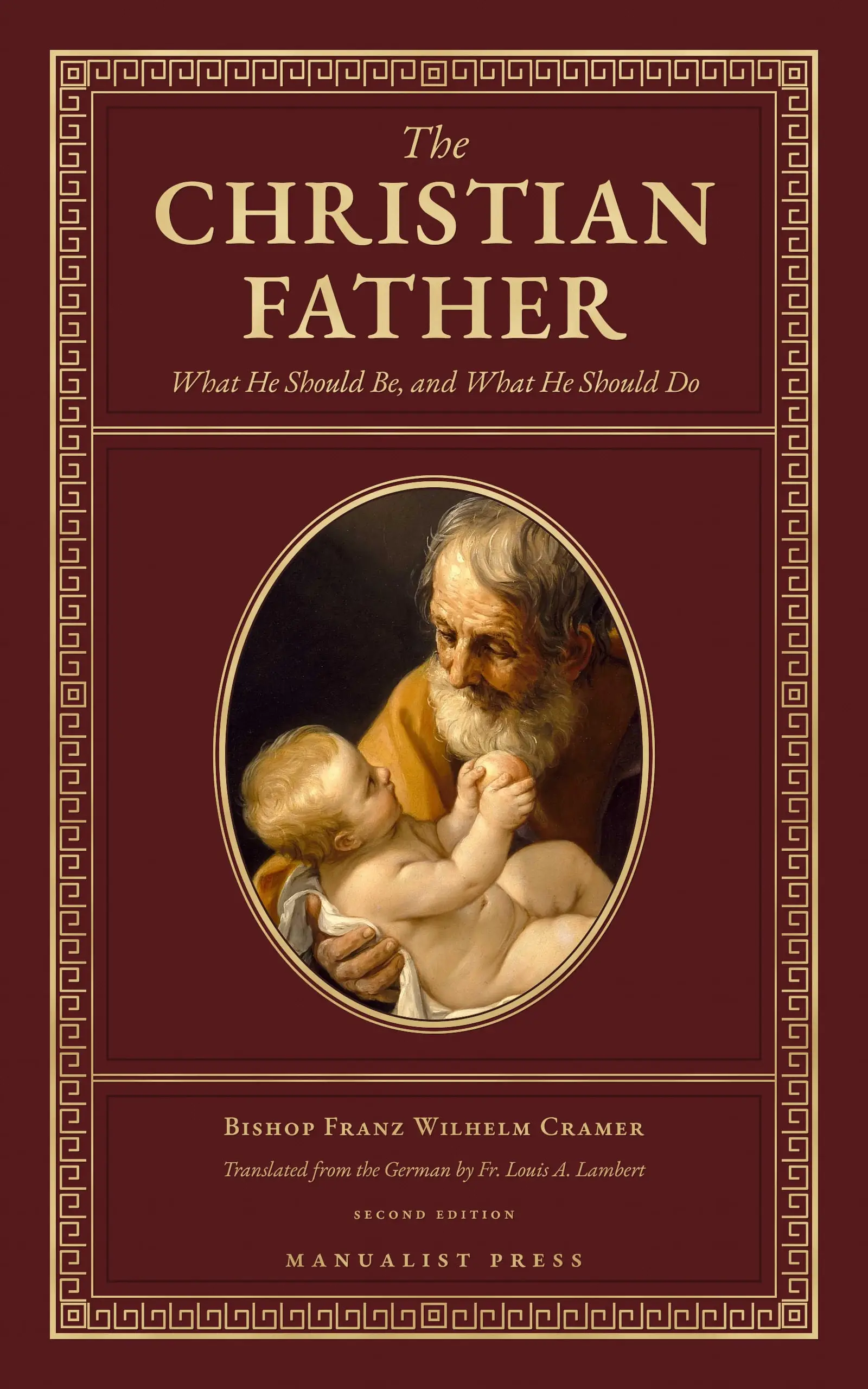
The Christian Father
What He Should Be, and What He Should Do
Bishop Franz Wilhelm Cramer, 1883
In many Catholic homes the mother does the praying. Bishop Franz Wilhelm Cramer wrote this short book for the father in such a home, and he does not let him off. A mother can teach the children all she likes, he says, but they copy their father, and if he treats the faith as her department they will learn to do the same. He meets the objection that church is a woman’s business: a father does from duty what a mother does by inclination, and his way is harder, but nothing asked of him here is beneath a man.
The advice is plain enough to act on this week. Say your prayers morning and evening, and get to confession and communion every few weeks. Keep Sunday for church and the family, and if you like a glass with friends, fix the hour you leave and the amount you drink. Set hours for the house and a time by which everyone is home. When a child must be punished, choose the correction the way a workman chooses a tool, and never in anger. He adds that the years spent feeding, clothing, teaching, and correcting children are counted in heaven as works of mercy.
Near the end a priest remembers his own father, a Westphalian farmer who made his children toys, walked them through his fields on Sundays, taught them to pray there, and once left a stubborn boy locked in the barn until evening. The second part is two dozen prayers written for a father: morning and evening, at Mass, on his wedding anniversary, for his wife, for his children’s patron saints, and a Litany of the Christian Father.
The first page of The Name of Father

The Name of Father
“Father:”—one of the first words uttered by infant lips, the first fruit, as it were, of the precious gift of speech, offered in honor of the Father in heaven and the father on earth, to whom we are indebted for existence and language.
Father: what a venerable name! It was pronounced from all eternity to express the mysterious relationship existing between the first two persons of the Deity. When God called men into being they addressed him by the name of “Father.” And such he was; for he made them his children, and as his children he endowed them with the highest gifts.
And when by sin they lost this high privilege of being children of God, he himself, in the second person of the Trinity, came down upon earth and restored to them that holy prerogative. This was the precious fruit of the life and works, the suffering and death of the Redeemer.
Contents
Related Books
Check your inbox
Confirm from the email we sent before any prayers arrive.
Edition & sources
Edition
- Translator
- Father L. A. Lambert
- Introduction
- Bishop Stephen Michael Vincent Ryan
- Source edition
- The Christian Father, Benziger Brothers, 1883
- This edition
- Manualist Press, September 2025
- Paperback
- 104 pages, 6 × 9 inches, ASIN B0HCCNBV5N
- Hardcover
- 104 pages, 6 × 9 inches, ASIN B0HCCWQK9Z
- Kindle
- 144 pages, ASIN B0FPYRM632
- Sample
- Introduction and The Name of Father
- Plate
- Georges de La Tour, St. Joseph the Carpenter, 1642. Musée du Louvre.
The text follows the 1883 Benziger Brothers edition, translated from the German by Fr. Louis A. Lambert, with Bishop Stephen V. Ryan's introduction.
Thank you.
Report a mistake
Manualist Press is a small family press. If these pages help you pray, you can support the work.
