Chapter XVII
Lost in the Temple
Every year the Jews from far and near used to gather at Jerusalem to keep the great Feast of the Passover. For one week the city was so packed that it was difficult to walk in the streets, and those who came after all the houses were filled had to pitch their tents in the fields or on the roadside. Great herds of oxen and flocks of sheep were driven into the city and up to the temple. Here they were sold as victims for the sacrifices and filled the air with bellowing and bleating. Each family bought a lamb to take home, and on a certain night, if less than ten, invited a number of guests to eat with them the lamb of the Passover. The animal was killed and placed on two branches of a pomegranate tree, which does not easily burn. One branch ran through the whole length of the body and the second and shorter one crossed the breast, holding the forelegs straight out so that the lamb lay in the shape of a cross. This had to be done very carefully, for if any one broke the smallest bone, he was punished with forty strokes of a whip. Then the lamb was roasted and placed on the table with wild parsley and bitter herbs and bread like a thin dry paste, for it was made of flour and water only. And the father of the family mixed water and wine in a cup which was passed around so that each one might drink a little. And the lamb was carved and every bit of it had to be eaten. Then all sang prayers to God.
When Jesus was twelve years old, He went to Jerusalem to keep for the first time the Feast of the Passover. It was a week of much praying and of great joy, and when it was over, the city was turned upside down with the excitement of leaving friends and relatives and gathering up bundles and packing camels and mules and forming traveling groups, for people from the same city journeyed together. The men left by one gate and the women by another, but after a certain distance they came together. Children could go with either father or mother. St. Joseph fell in with a group of men going to Nazareth and, though he knew most of them, he longed to be with Jesus and His Mother. And the Blessed Virgin sorely missed our Lord, but never doubted that He was with St. Joseph. In the evening when they met, they found that the Child had not been with either of them. Where was He? They forgot that they were tired and hungry and at once turned back. They asked each band of travelers on the way whether they had seen their Son. “How old is He?” “Twelve years old.” “What does He look like?” “He looks just like His mother,” said St. Joseph, pointing to the Blessed Virgin. “No, we have not seen Him.” On they pressed until it grew so dark that it was useless to continue. So they laid down on the bare ground, but could not sleep for thinking what could have happened to Jesus. How could they have lost Him? When they were getting ready to leave Jerusalem, He was with them. Could He have got in with a caravan starting for some far-off city? Could wicked men have stolen Him? Could He have been crushed in the crowd and badly hurt? Oh, where and how was He spending that night? And, most terrible thought of all, was it through carelessness on their part that He was lost? Yet they could not see that they had been careless.
In the gray of early morning, they were again on the road, and by noon had reached Jerusalem. Up one street, down another, ever asking the same questions, ever getting the same answers, when night came they had found no trace of Him.
At last on the third day, they climbed the marble steps of the temple. In one of the great halls, the most learned of the Jews used to gather to talk over things in the Bible, and a crowd of strangers had stayed after the Feast to listen to the wise things that were said. A number of boys were sitting on the floor trying to catch what they could, for there were no schools in those days and this was their only chance to learn. But one of the boys was standing and, instead of listening, was talking, and a hush was over that great crowd and all strained their ears to catch His words, for never had a child been heard to speak like this one.
The clever Jewish doctors saw that He knew more than the wisest man among them, and they stroked their long white beards and shook their snowy locks and asked: “Who is this Boy? Where does He come from?” And some one answered: “He comes from Nazareth. He is the Son of Joseph the carpenter.” At this they were puzzled more than ever, for if He was a poor carpenter’s son and lived in the little town of Nazareth, He had never studied. Then where could He have learned all He knew? Again they spoke to the Child and tried to catch Him with the hardest questions they knew. But He answered every one so clearly that they marvelled all the more. Then He asked them some questions, but they frowned and bit their lips and jerked their long robes about their knees, for, try as they would, they could not answer.
And the Boy fearlessly spoke on in His clear, high voice, and showed them that it was time for the Redeemer to come, that He had come and that though they could not understand how He knew all things, it was because He Himself was the Savior who had come to teach them about His Heavenly Father and to save their souls.
Just then two sad, worn figures stopped in the doorway and looked in. O the relief, the joy that came into their faces! The Child turned and saw them and ran to them and threw Himself in His Mother’s arms, and she cried out: “Son, why hast Thou done so to us? Behold Thy father and I have sought Thee sorrowing.” (Luke 2:48.) And He asked in surprise: “How is it that you sought Me? Did you not know that I must be about My Father’s business?” (Verse 49.) Yes, this had been His time to let the Jews know that the Redeemer had come and much as He loved His Mother and much as it hurt Him to make her sad, He had first to look to the work His heavenly Father wanted Him to do. But could He not have told them where He was going, so that they would not worry? Yes, and He would have, had He not had some good reason for not doing so. But Mary and Joseph would not now give up that three days’ sorrow for anything in the world; for now they see the reason of it, now they see that it was best, now they see that they were not careless but that God let them suffer so that He might draw them all the closer to Himself in Heaven.
So, too, God still lets men and women, boys and girls, suffer many things, and often they cannot see the reason why. Some silly persons say: “I don’t see why God let that man die. His children need him so badly”; or, “I don’t see why God lets that good woman have so much trouble”; or, “I don’t see why God lets me suffer so much.” But wise persons say: “God has let this trouble come, so it must be for the best. And though I cannot now see why, some day I shall.”
Then Jesus left the temple with His Mother and St. Joseph, whilst the crowd watched in wonder. Soon, in little groups, they too left the hall, talking excitedly about the Boy from Nazareth.
O what happiness for Mary and Joseph to have Jesus with them once more and what happiness for Jesus to be again with the two persons He loved best. And He told them where He had been and what He had done and how He missed them during those sad three days and that He never could have left them had it not been the will of His heavenly Father. Their hearts were so filled with joy that the journey seemed very short, and they were not a bit tired when they caught the first sight of their little cottage in Nazareth. There life was again just what it had been, whilst month by month Jesus grew taller and stronger and, it almost seemed, more beautiful, and He learned the trade of His foster-father and helped him in his work. Yet all these years He was obedient to Mary and Joseph.
And every boy and girl must be obedient to his parents, too. This is often very hard, but you are strong and like to do hard things, and you can just think a moment of the Child Jesus and say: “All for Thee, dear Jesus,” and then set about doing what your father or mother want you to do. And you will be much happier and God will love and bless you for it. Some children think it is smart to talk back to their parents and to say “I won’t,” and sometimes they think they know even more than their parents know. But nice boys and girls do not act like this. They are polite to their father and mother and try to help them and, when they go to school, they obey their teachers, too.
Unless your parents should tell you to do something wrong, as to steal or to tell a lie, you must always obey them. God is very particular about this and every time you disobey them or are rude to them, He sees you and will punish you for it.
When you go to church, thank our Lord for giving you your parents, ask Him to bless them and to make you obedient to them.
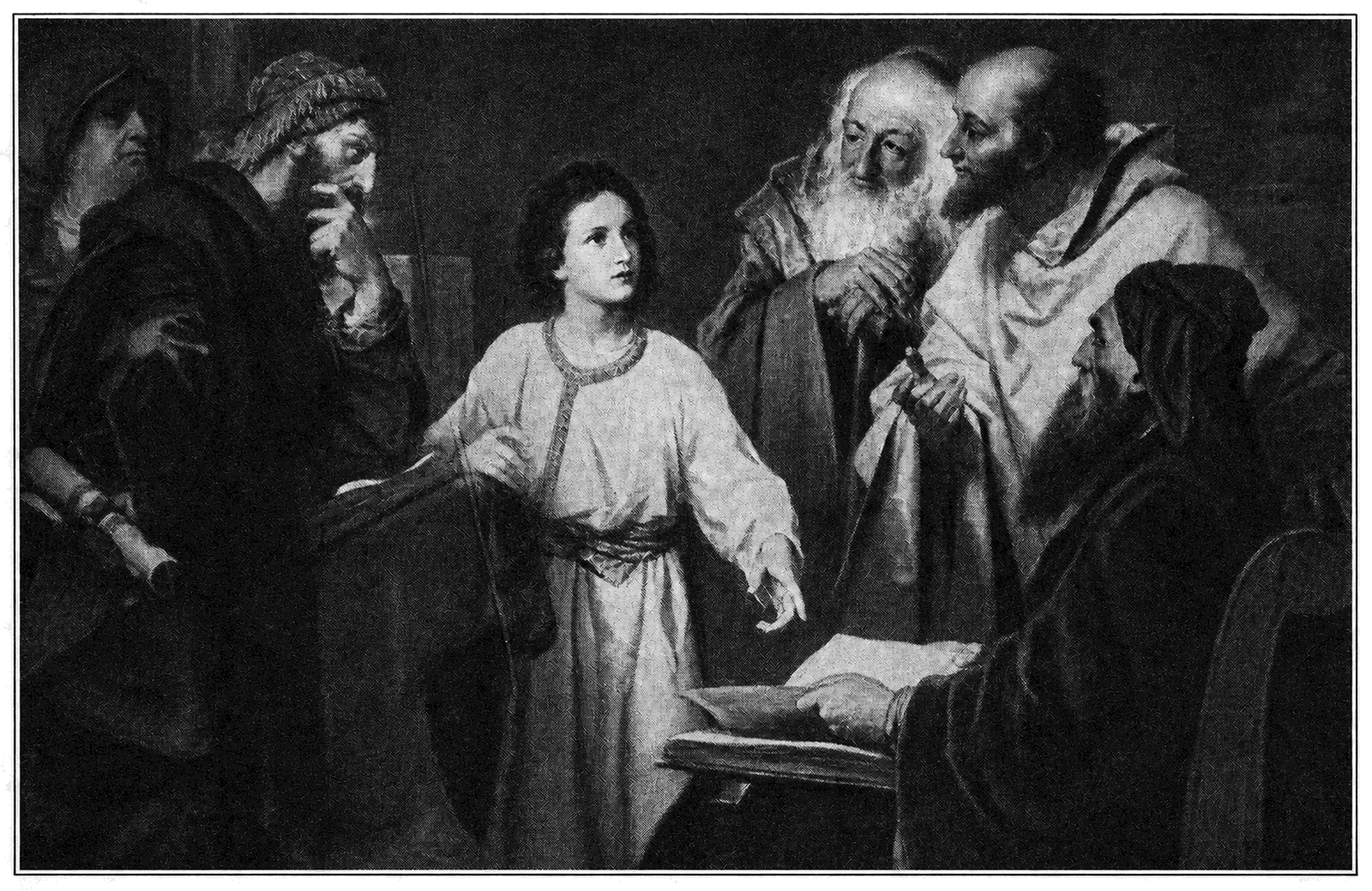
And all that heard Him were astonished at His wisdom and His answers. (Luke 2:47.)
