Chapter X
The Harp Player
God was the king of Abraham’s people, the Jews. He took care of them and told them what to do. But after a time they wanted one of their own men for a king. Weren’t they foolish to want a man to rule over them instead of God? So they went to their judge, Samuel, and told him they must have a king. Samuel spoke to God, who told him to tell the Jews that it was wrong for them to want any one to take His place, and that, besides, if they had a king, it would bring them a great deal of trouble, for the king would have to live in style, and they would be obliged to give him many servants, and horses, and chariots, and oxen, and sheep, and a part of their crops.
When the people had heard all this, they still insisted upon having a king, so God let them have their own way, and chose from among them a good man named Saul. The Jews were pleased with their first king, for he was fine looking, and so tall that he stood head and shoulders above them all.
All went well for a couple of years, and then Saul disobeyed God, and an evil spirit came upon him. He would sit for hours in a terrible rage in his tent, and his servants were afraid to go near him.
At that time there was living in the little town of Bethlehem a man named Isai, who had eight sons. The youngest, named David, took care of his father’s sheep on the hillsides. He was a strong, beautiful boy, and loved God with all his heart, and wasn’t afraid of anything. He was very skillful with his sling. It wasn’t the kind of sling you use, but was a sort of leather bag in which shepherds placed a stone and then whirled round and round so that the stone flew out with a great deal of force. In some parts of the world shepherds still use them, and some boys aim very accurately, so that they seldom fail to hit an object, though it is a great distance away. And David could play the harp so sweetly that he charmed all who heard him.
Now, one day, when Saul was in a fit of anger, someone thought of David, the little shepherd boy, and told the king how beautifully he could play. Then the king sent for David, and when he felt the bad spirit stealing into his heart, the boy would bring the harp and play so sweetly that the evil spirit left, and the king was himself once more.
At this time the Jews had for neighbors a warlike people, called the Philistines, with whom they were always fighting. Now Saul and his men went out to meet the enemy’s troops, and David returned to his flocks. The Philistines were drawn up on a mountain, and the Jews placed themselves on another mountain, so that there was a valley between them.
The Philistines had an enormous giant. He carried a great helmet of brass on his head, and wore a coat of mail, made of big scales of metal, and his legs and shoulders were covered with brass, and he twirled an immense spear with a huge iron head.
Every day he came out of his tent and strutted up and down in front of the camp, brandishing his spear and roaring out for one of the Jews to come forth and fight. But no one dared to meet Goliath, the giant, alone. Day after day he repeated his challenge, but none ventured out, for fear clutched at the hearts of Saul’s men.
Isai’s three oldest sons had joined the king’s army, and one day their father sent David to the camp to carry food.
For the first time David saw Goliath, and heard him dare any one to fight. But all the warriors slunk into their tents.
Thereupon David spoke to the king and said that he would fight the giant. But Saul told him that he could not, for he was only a boy. Then David told the king how one day he was guarding his father’s sheep when a lion and a bear came upon the flock and carried off a ram; how he went after them and struck them and saved the ram; and how when the beasts then attacked him, he caught them by the throat and killed them.
“And David said: ‘The Lord who delivered me out of the paw of the lion, and out of the paw of the bear, He will deliver me out of the hand of this Philistine.’ And Saul said to David: ‘Go, and the Lord be with thee.’”
“And Saul clothed David with his garments, and put a helmet of brass upon his head, and armed him with a coat of mail.”
“And David having girded his sword upon his armour, began to try if he could walk in armour, for he was not accustomed to it. And David said to Saul: ‘I can not go thus, for I am not used to it.’ And he laid them off.”
“And he took his staff, which he had always in his hands, and chose him five smooth stones out of the brook, and put them into the shepherd’s scrip, which he had with him, and he took a sling in his hand, and went forth against the Philistine.” (1 Kings 17:37-40.)
And Goliath came forth, and when he saw David coming to meet him, he laughed at one so young, and asked whether he thought him a dog, that he came against him with only a stick in his hand. Then he cursed the boy and said: “‘Come to me and I will give thy flesh to the birds of the air, and to the beasts of the earth.’
“And David said to the Philistine: ‘Thou comest to me with a sword, and with a spear, and with a shield: but I come to thee in the name of the Lord.’” (44-45.)
And David hurried and ran to meet the giant. “And he put his hand into his scrip, and took a stone, and cast it with the sling, and fetching it about struck the Philistine in the forehead: and the stone was fixed in his forehead and he fell on his face upon the earth.” (Verse 49.)
Then David ran up to Goliath, and, drawing out the giant’s sword, cut off his head and held it up for all to see.
At this the Philistines were so frightened that they fled, and Saul’s army gained a great victory; and the people came out to meet David, and all praised him and made more of him than of the king, for there was none like him in all the land.
Years later, David became king of the Jews. He was a man after God’s own heart and told some sad things about the Redeemer who would one day be born in his family. He said that men would make terrible wounds in His hands and in His feet.
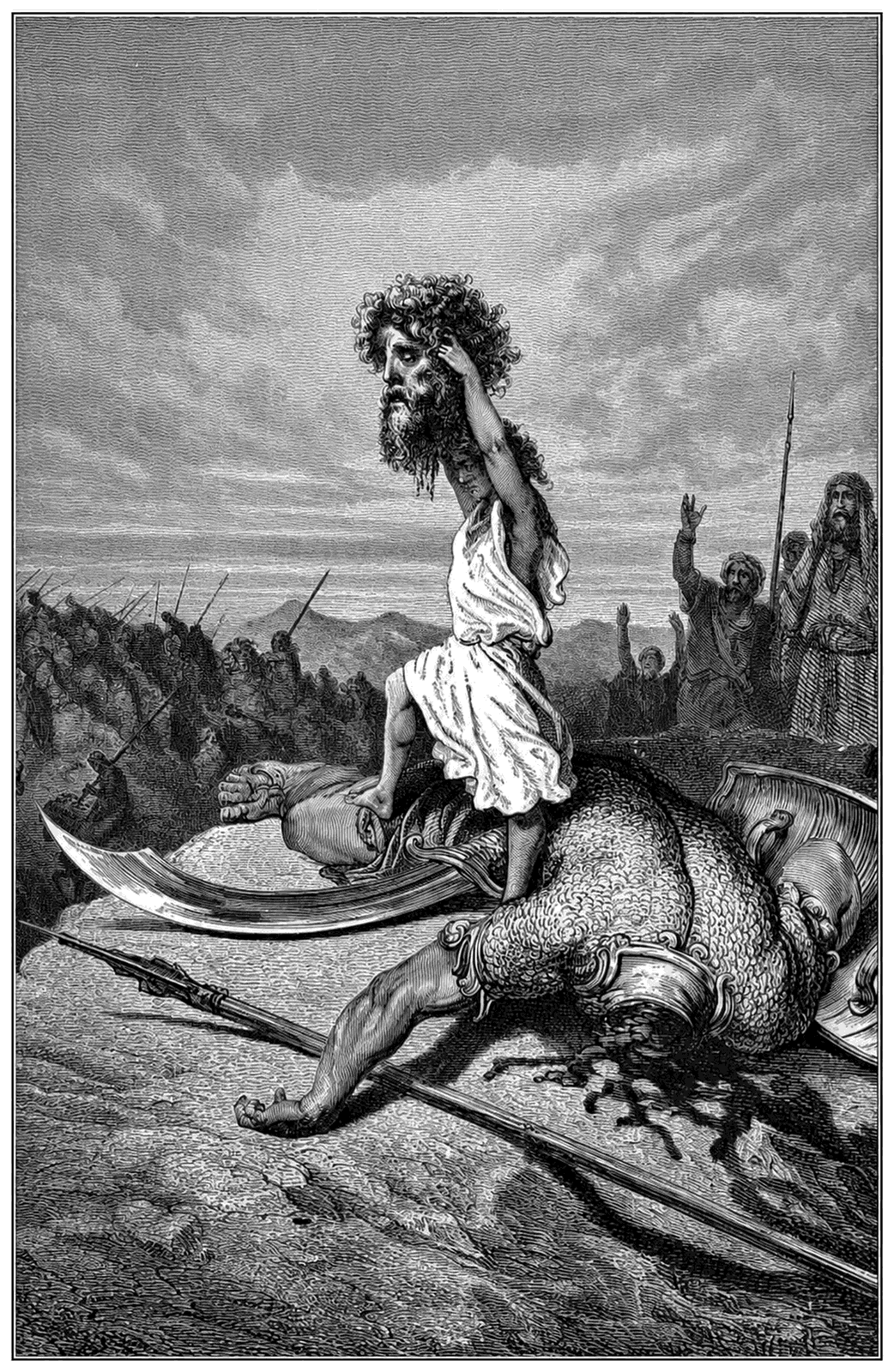
He ran, and stood over the Philistine, and took his sword, and drew it out of the sheath, and slew him, and cut off his head. (I Kings 17:51.)
