Chapter VIII
The Three Guests
Long after the great rain there lived a good man named Abraham. He was very rich, and had many servants and camels and herds of cattle and flocks of sheep.
One evening God came to him and told him that He would make him the father of a great people who would be His favorite nation, and that to count them would be as easy as to count the grains of sand on the seashore; and that among his people would one day be born the Redeemer, who would open Heaven to the whole world.
Then Abraham gathered all he owned, and taking his wife, Sara, and his nephew, Lot, travelled to the beautiful new country to which God led him. The land was to be the home of the chosen race that would call Abraham their father. These people are now scattered over the whole world, and we call them Jews.
After a while Abraham thought it would be best for him and his nephew to separate, so that they might each have more land on which to pasture their flocks. So Lot left and went to live in a very bad city, called Sodom.
One day, in the heat of the noon-time, Abraham was sitting at the door of his tent. Looking up, he saw three strangers coming toward him. At once he went to meet them, and found them to be young men of great beauty. He invited them to stop with him, and went into the fields and picked out a fine young calf, which he had killed and cooked for dinner. Then he told Sara to bake some hearth-cakes, and he brought out milk and butter, and the strangers ate beneath the shade of a tree whilst he stood by.
When they had eaten, they told him that God was going to give him a son. Abraham and Sara were very glad to hear this, for they had no children.
Abraham walked with the angels when they left, and he saw that they took the road to Sodom. They told him that God was offended by the sins of that city, and was going to destroy it.
Then Abraham began to pray, and begged God not to destroy the good with the wicked, and asked whether He would spare the city if there were fifty just persons within it, and God said He would.
But there were not fifty good persons in the whole place. So Abraham begged God to spare the city if there could be found forty-five good persons, and God said He would. Then getting bolder in his prayers, he asked God to spare the city if there were only forty, then thirty, then twenty, then ten good persons, and God said He would. But among all the people not even ten just men could be found.
Then Abraham went home very sad, and the two angels entered into the city to warn Lot, for God wished to spare him on Abraham’s account.
The next morning the angels took Lot and his wife and his two daughters by the hand, and hurried them away, and told them not to look back. When they were at a safe distance, fire and brimstone fell from heaven, and the city and all the country about was destroyed.
Lot’s wife, in spite of the angels’ warning, looked back to see what was happening, and at once she was turned into a pillar of salt.
Early that same morning Abraham got up and looked towards Sodom, and saw the whole place on fire, whilst the flames and smoke arose as from a mighty furnace. But Lot and his daughters took refuge in the mountains.
Abraham and Sara called the son God sent them Isaac, and when the child had grown to be a young man, God said He wanted back the life of the boy He had given. Poor Abraham was broken-hearted as he listened, for God told him to take Isaac and kill him with his own hand.
Abraham was accustomed to offer to God from time to time the best of his sheep and cattle by killing them. This was called offering sacrifice, and the animal that was slain was called the victim. People had always offered sacrifices, for God Himself had taught Adam and Eve to do so after they had sinned. Sacrifices were offered so that men would not forget that everything they had belonged to God, that sin brought suffering into the world, and that they should be ready to give not only the lives of the animals, but their own lives, to make up for their sins.
All this Abraham had done, but never before had God asked for the life of a person. Still, Abraham did not hesitate. He knew that both he and his son belonged to God, who had a right to their lives, and above all, he loved God with his whole heart, even more than he loved Isaac.
So he got up in the night and took with him two young men, and his son; and, when he had cut wood for the sacrifice, they started on their journey.
On the third day they came to the mountain, and Abraham told the young men to wait there whilst he and the boy went farther to worship God. He placed the wood on Isaac’s shoulder, and carried in his hands fire and a sword.
As they climbed up the mountains, Isaac, who knew they were going to offer sacrifice, asked his father where the victim was. But his father could only answer that God would see to that, for he could not bear to tell him that he himself was the victim.
At last they reached the top of the mountain, and Abraham built an altar and laid the wood on it, for, after he had slain the boy, he would burn his body. Then he tied Isaac and laid him on the wood, and raising the sword was just going to kill him, when an angel seized his arm and stopped him. The angel told him that God had only done this to try his love, and to see whether he was willing for His sake to kill his only son he loved so much. Then the angel pointed to a ram that was caught by the horns in a bush nearby, and told him to sacrifice the animal, but not to hurt Isaac.
God was pleased with Abraham, and told him that He would bless him and his children’s children, and promised once more that among his people would be born the Redeemer, the Saviour of the world.
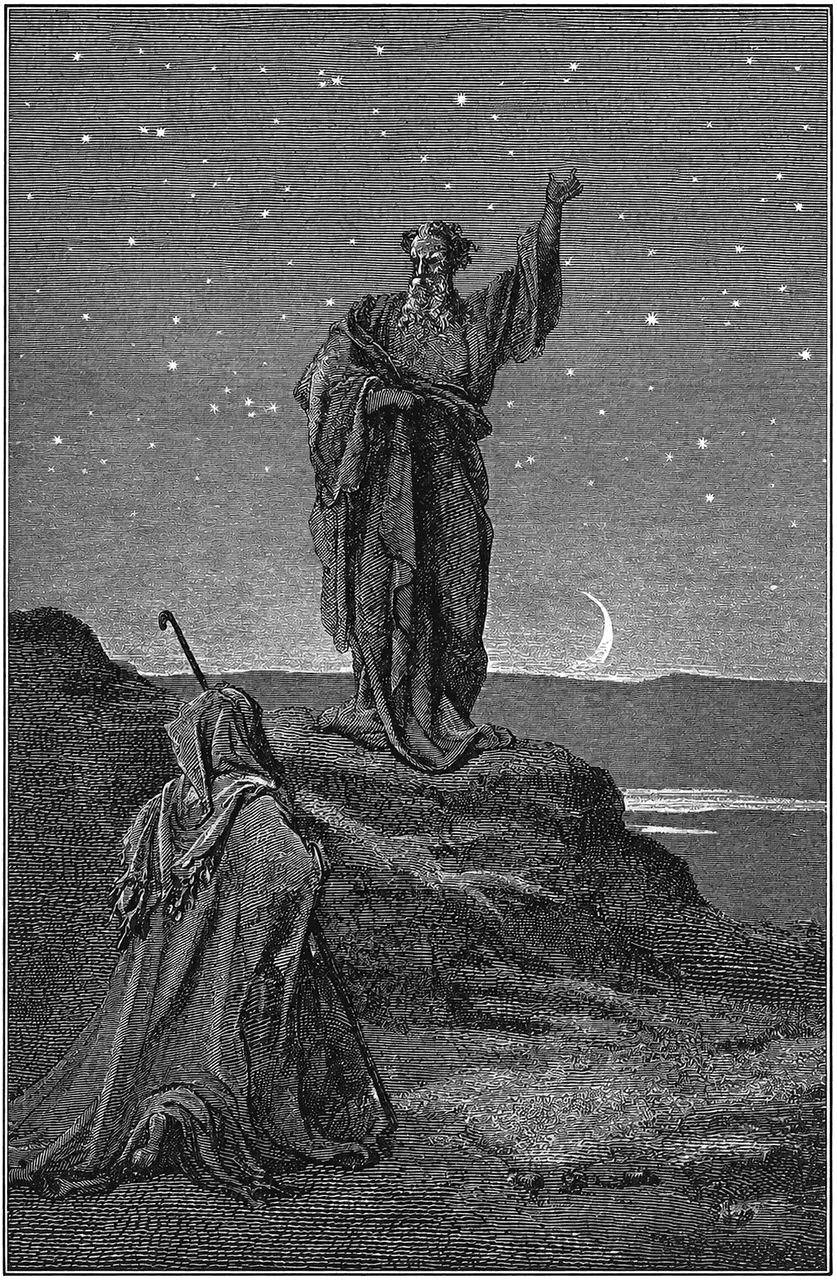
And the Lord God said to Abram: “Go forth out of the country … and come into the land which I will show thee. And I will make of thee a great nation, … and in thee will all the kindred of the earth be blessed.” (Gen. 12:1, 2, 3.)
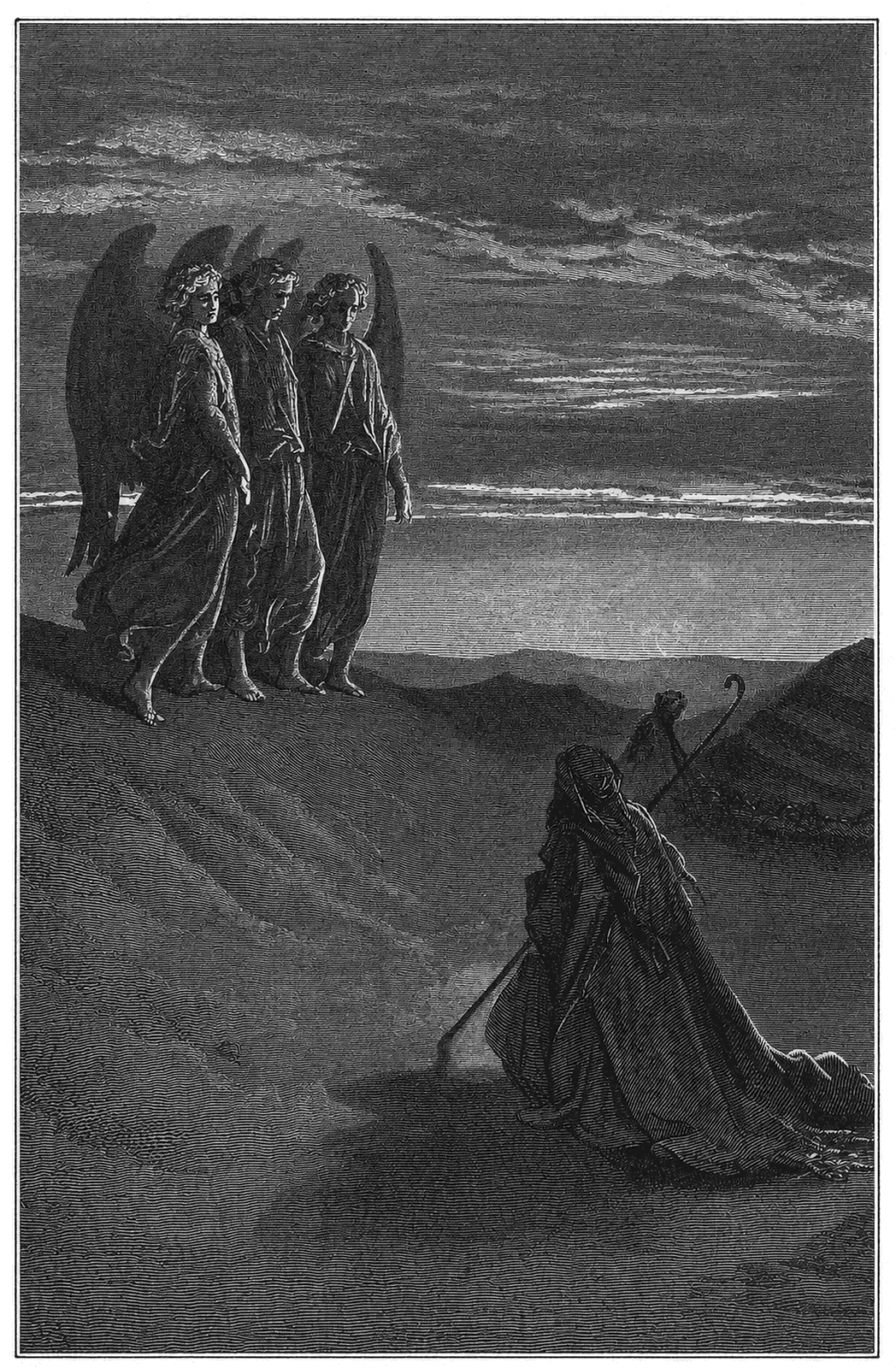
And as soon as he saw them he ran to meet them from the door of his tent, and adored down to the ground. (Gen. 18:2.)
