Chapter XIV
The Den of Lions
Once there was a little boy named Daniel. He was very good and very smart, and being a Jew, he knew how to pray to the true God. Now many little boys in those days, as nowadays, had never heard about God, for the people had turned their backs on their Creator, all except the Jews. The rest made gods for themselves out of wood and stone and iron and brass and silver and gold, and they bowed before them and offered them sacrifices, and asked them to cure them of their sicknesses and give them victory when they went to battle. This was very wrong and very silly, for how can a stick or stone help anyone?
Others called some of the animals, as cows and alligators and snakes, gods. They prayed to them and gave them fine things to eat on costly dishes.
One terrible god was called Moloch. He was hollowed out of iron and filled with fire. When the flames leaped high, they placed poor little babies in his arms. Then the awful arms dropped the baby into the burning fire. They said that was the way Moloch ate little children, and that he liked them better than anything else.
One day the enemy came from Babylon and destroyed Jerusalem, and ruined the beautiful temple where the Jews prayed and offered sacrifices. Then they took all the men, women and children prisoners and carried them back to their own country. Thus Daniel and his playmates grew up in a strange land.
It so happened that the king of Babylon made an immense statue of gold, and when it was finished, he sent for all the great men in the country to come and see it. A large crowd gathered and a herald cried out that when the musicians played, all must fall on the ground and adore the golden statue, and that if any one refused, he would be thrown into the fiery furnace.
The musicians started, and all the people bowed down. But some one ran to the king and told him that three young Jews had refused to adore the statue. Then the king sent for them and told them that they would have to adore the statue. But the young men, who were friends of Daniel, told the king that it was wrong to adore a god made by men, and that they would only adore the one true God in Heaven, who was able to save them from the flames; and that even if He did not wish to do so, they would rather be burned to death than commit such an awful sin.
Then the king ordered the furnace to be made seven times hotter than usual. And the men threw pitch and dry wood into the furnace and cast the three young Jews into the burning fire. But flames shot out and burned up the men who threw them in.
And an angel came down from heaven and parted the flames and took care of God’s three friends, so that a cool breeze seemed to blow about them, and their garments were not even scorched, nor was a hair of their heads singed, nor was even the smell of fire upon them.
And the king heard them singing in the midst of the flames, and praising God, and he was astonished and went to the door of the furnace and bade them come out. And the three young men came forth from the fire unhurt, and when the king saw how powerful their God was, he ordered all the people to honor the God the Jews honored.
As time went on, the king saw that there was no one in his whole kingdom like Daniel, and so he wanted to place him over all the rest. Now some of the nobles, seeing this, grew very jealous, and tried to think how they could hurt Daniel in the eyes of the king. But Daniel was so holy that they could not find a single wrong thing that he did. At last they settled on a plan and went to the king and asked him to make a law forbidding any one to pray or ask a favor from any god or man, except the king, for thirty days, and to say that if anyone disobeyed, he would be thrown to the lions. The king agreed and the law was passed.
When Daniel heard what had been done, he went up to his room, as usual, and kneeling with his face turned towards Jerusalem, he prayed with all his heart. Thus he prayed three times a day.
The nobles were watching to catch him, for they knew that this was what he would do. Then they went to the king and told him that Daniel had disobeyed the law and must be thrown into the lions’ den. The king grew sad, for he loved Daniel, and all day, even until sunset, he planned to save him from the hungry lions. But the nobles saw what the king was trying to do, and they told him that once he had made a law he had to keep it.
Then they brought Daniel and threw him into the den of lions, and placed a stone at the mouth of the den, and the king sealed the opening with his own ring so that no one could enter. Then he went home grieving, and his supper was put before him, but he could not eat, and all night he lay on his bed, but could not sleep. Very early in the morning he got up and hurried to the den and called: “‘Daniel, servant of the living God, hath thy God … been able … to deliver thee from the lions?’” (Dan. 6:20.)
And the answer came back: “‘O king, live forever: My God hath sent His angel and hath shut up the mouths of the lions, and they have not hurt me. …’
“Then was the king exceedingly glad for him, and he commanded that Daniel should be taken out of the den: and Daniel was taken out of the den, and no hurt was found in him, because he believed in his God.”
“And by the king’s commandment, those men were brought that had accused Daniel: and they were cast into the lions’ den, they and their children, and their wives: and they did not reach the bottom of the den, before the lions caught them, and broke all their bones in pieces.” (21-24.)
“Now the Babylonians had an idol called Bel: and there were spent upon him every day twelve great measures of fine flour, and forty sheep, and sixty vessels of wine.”
“The king also worshipped him, and went every day to adore him: but Daniel adored his God. And the king said to him: ‘Why dost thou not adore Bel?’”
“And he answered and said to him: ‘Because I do not worship idols made with hands, but the living God, that created heaven and earth. …’”
“And the king said to him: ‘Doth not Bel seem to thee to be a living god? Seest thou not how much he eateth and drinketh every day?’”
“Then Daniel smiled and said: ‘O king, be not deceived: for this is but clay within and brass without, neither hath he eaten at any time.’” (Dan. 14:2-6.)
Then the king was angry, and he sent for the priests and told them that if they could not prove that Bel ate the sheep and the flour and drank the wine they put before him every night, they must die; but that if they could prove it, Daniel must die.
Now there were seventy priests, besides their wives and children, and they told the king to place the wine and the flour and the sheep before Bel, whilst they went out, and to shut the door and seal it with his own ring; and that if when he came in the morning, he should find that the god had not eaten all, they would be willing to die.
The priests were not afraid, for they had a secret door under the table, and every night they stole in through it and ate up all the food.
When the priests had gone and the king had placed the food before the idol, Daniel had his servants sprinkle fine ashes over the floor. Then they fastened the door, and the king sealed it with his own ring, and they went home.
In the night the seventy priests and their wives and children came in through the secret door in the floor and ate and drank all that had been set before Bel.
And early in the morning the king came to the temple with Daniel, and the seal was unbroken, so that he was sure that no one had entered. When they opened the door the king cried out that Bel was a great god, for he saw that all the food and wine were gone. But Daniel held the king back and told him to look carefully at the floor and see the footprints in the ashes. And the king was very angry, and said: “‘I see the footsteps of men, and women, and children. …’ Then he took the priests, and their wives, and their children: and they showed him the private doors by which they came in.” (14:19, 20.)
Therefore, the king put them to death and let Daniel destroy Bel and his temple.
And God loved Daniel very much, and told him of things that would happen in years to come, and among these was the year of the Redeemer’s birth.
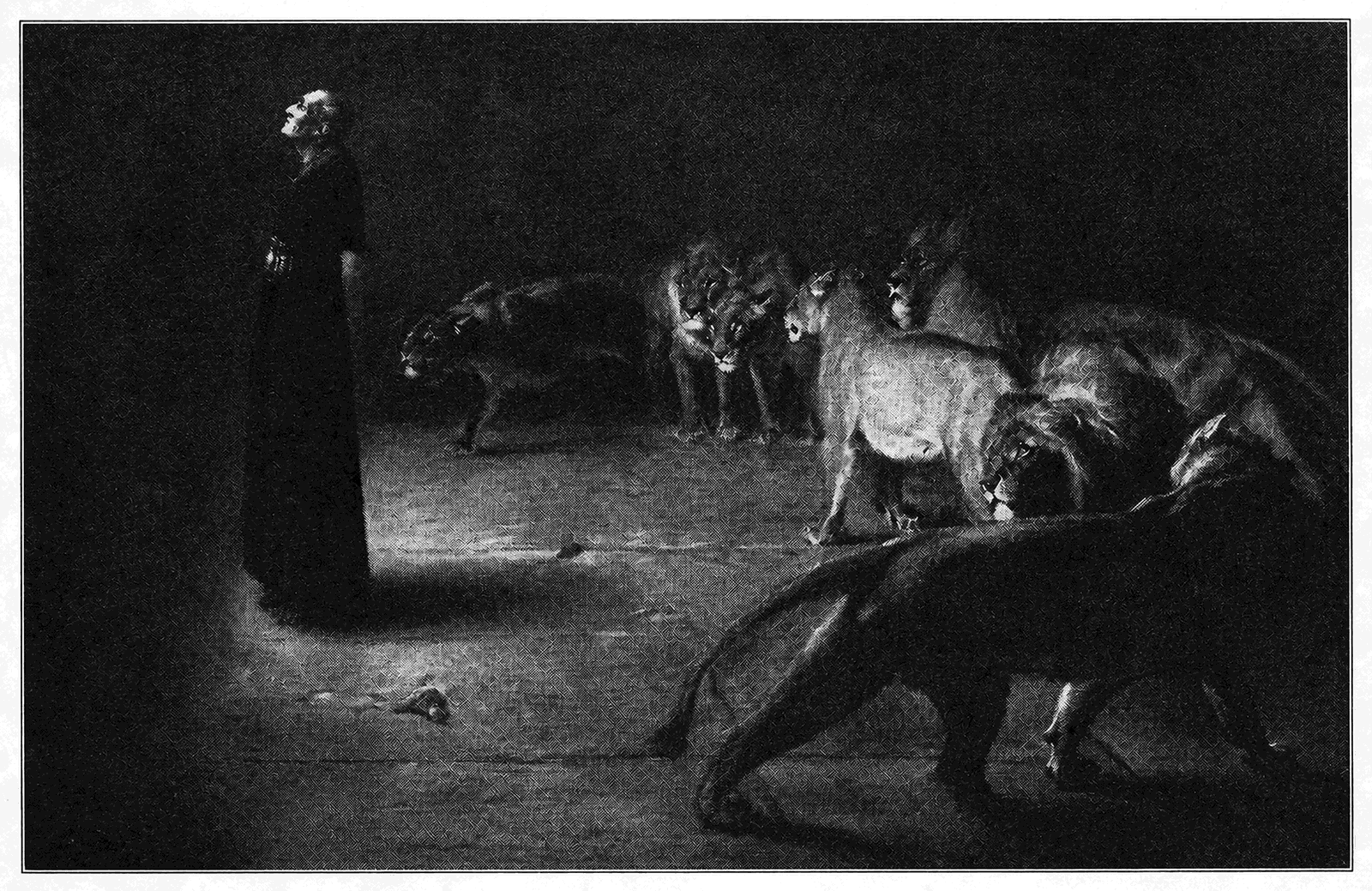
“My God hath sent His angel, and hath shut up the mouths of the lions, and they have not hurt me.” (Dan. 6:22.)
