Chapter X
Initiation Into Secret Societies
“What baptism is to the Christian, initiation is to the lodge-member.” The initiation into the ancient mysteries or secret societies of old is the model for initiation into the secret societies of today, and, as one is much like the other, the reason for the forms must be the same—only that there was more sense in the ancient mode than can be said of the modern. About the ancient mode of initiation Masonic writers say: “These rites, magnificent and impressive, and startling, by sudden transitions and striking contrasts, rites commencing in gloom and sorrow, and ending in light and joy, dimly shadowed forth the passage of man from barbarianism to civilization, from ignorance to science, and his constant progress onward and upward through the ages, to still sublimer elevations. The trembling and helpless neophyte, environed with terror and gloom, and pursuing his uncertain and difficult way through the mystic journey of initiation, which terminated in light and confidence, was a type or representative of humanity marching upward from the gloom and darkness of the primitive state of barbarism to a high degree of enlightenment, of social refinement and perfection. The mystic ceremony was, therefore, emblematic of the progressive development of man, and was intended as an aid to that development.”
“… the true end and purpose of the mysteries, the first and greatest end thereof, were, according to the ancients, to civilize savage people, soften their ferocious manners, render them social, and prepare them for a kind of life more worthy of the dignity of man.” (McCoy, Direct. of Masonry.)
To betray the mysteries was everywhere considered infamous, and the heaviest penalties were attached to it; hence also, in all initiations the candidate had to take the most horrible oaths that he would keep the secrets entrusted to him. Alcibiades was banished and consigned to the Furies for having revealed the mysteries of Ceres; Protheus, Tantalus, Oedipus, Orpheus and others suffered various punishments for the same reason. The candidate had to undergo the purification by Fire, Air, Water and Earth.
We are told that the rite represents man in his primitive condition of helplessness, ignorance, and moral blindness, seeking after the mental and moral enlightenment which alone can deliver his mind from all thralldom and make him master of the material world. The Neophyte, in darkness and with tremblings, knocks at the door of the lodge, and demands admission, instruction and light. So man, born ignorant and helpless and blind, yet feeling stirring within him unappeasable longings for knowledge, knocks at the door of the temple of Science. He interrogates nature, demands her secrets, and at length becomes the proud possessor of her mysteries.
The Rev A. B. Grosh, in his Improved Pocket-Manual of Odd-Fellows, has the following to say about initiation: “Every Odd-Fellow should keep clearly impressed on his mind and heart the lessons taught at initiation. They are a guide to understand properly all that follows after an epitomized summary of the great principles and objects of the Order. They contain the germs which after-instruction and his own practice should develop and mature into blossoming and fruitfulness. In one word, ‘what regeneration by the word of truth is in religion, initiation is in Odd-Fellowship.’”
“A thoughtful man’s first entrance into a lodge, unknowing what is to be transacted there, is a serious event. There, for a time, he is to be isolated from general society, in a retreat sacred to benevolence and peace, away from the world, with its selfish toils and cares, its factitious distinctions and social vices, surrounded wholly by those who have avowed to devote their lives to fraternity in Odd-Fellowship (secret societies). His object is to learn their principles, to assume their vows, to unite in their labors. That he may do so properly, they require him to pass through rites which shall teach him his present condition as a social being, and the primary principles of the condition he is about to enter.”
“Consider then the social state of man without knowledge and practice of those relations which bind him to his Creator and his fellows. How isolated his position; how surrounded by the darkness of ignorance on every side; how feeble, helpless, dependent, in a world that appears adverse and antagonistic? If he find a guide, he knows not whether to trust or doubt him; and he is yet in such need of one that he follows whithersoever he is led.”
“Himself bound by his ignorance and fears, in the indurating fetter of selfishness, he knows not that any have more light and freedom than are his; and yet, not fully realizing his own need of both, he may marvel if told that nearly all mankind are in darkness and chains which they neither behold nor feel. It is not till some voice greets his ear with a promise of instruction, that he begins to conceive that the chaos around him may be resolved into order; the discord to harmony. This conception leads him to desire that wisdom which shall shed light upon his darkness, and unravel the perplexities which bewilder the soul. And yet, the first ray of light will but increase the apparent gloom; for it will exhibit more strongly the vanity of human pursuits and possessions, the brevity of life and the certainty of death, and all life’s evils fearfully aggravated and increased by the strifes, discords, and dissensions which flow from human ignorance and folly and end at last in death itself.”
“Yet contemplate the scene. From all that gloom, light will shine forth to guide aright. It will humble human pride. It will awaken compassion for others. It will arouse the soul to a just sense of its responsibilities to God, and its duty to man. It will fill his heart with a salutary horror of that monster, Sin, whose power has arrayed man against his fellow-man and washed the earth with tears and deluged it in blood. It will bid him beware that his own heart does not cherish moral evil, that bane of happiness and peace, that fountain of discord and strife, that inflictor of guilt and shame, and woe and death, which must reign till men learn to obey the law of truth and love, and the earth is filled with righteousness and peace.”
“… Keep in remembrance the signs and words imparted to you, to enable you to enter these courts, and to recognize and be recognized by your brethren. Trifling as they may seem to some, they are the key to our treasures and our mysteries. And in their use, remember that they are pledges of secrecy to the brotherhood from you, and to you from us. Remember, also, that the Omniscient One observes your every discharge of duty and use of privilege. Let your hand, then, be open as day to greet a brother with frankness, or to aid him with cheerfulness and love. Show due courtesy to your brethren and salute respectfully those who preside over the lodge, as the representatives of the lodge itself. The forms through which you have passed are not what they seem to many. Under each act and emblem there is a deep significance. So in life. Apply your instructions there, and everything becomes vocal with wisdom. The eyes blinded by the darkness of a dungeon are naught to the blindness of the moral sense obscured by indulgence in selfishness and sensuality. The fetters on a martyr’s limbs, what are they to the chains which evil passions and bad habits impose on the inner man, and whose iron does indeed enter the soul? May your initiation and consequent practice aid in releasing you from all blindness of moral wisdom, set you free from the fetters of ignorance and error, and bring you from a death of selfishness into a life of active benevolence and virtue.” Thus far the Rev. A. B. Grosh. Surely he takes the initiation seriously, and so do thousands of others. I have been told by more than one person that they took their initiation just as seriously as the novice in Catholic religious orders when he makes his professional vows.
The Riding of the Goat
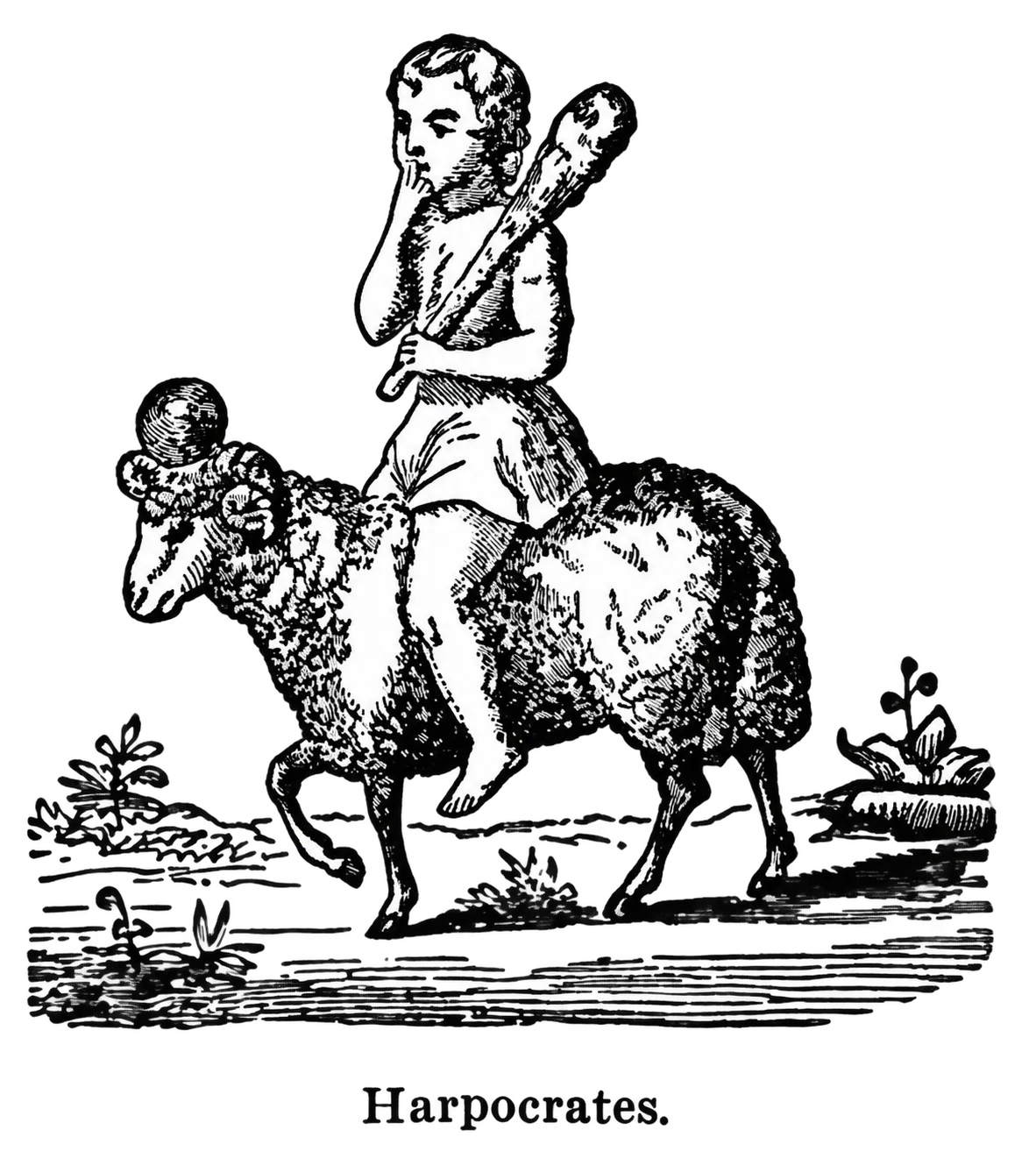
In most secret societies the riding of the goat is one of the features of initiation. Its meaning is this: “In Egyptian and Grecian mysteries Harpocrates was considered the son of Osiris and Isis. He was believed to have been born with his finger in his mouth, as indicative of secrecy and mystery. The Greeks and Romans worshipped him as the god of quiet life, repose and secrecy. He is described by Plutarch as lame in the lower limbs when born. He is represented mounted on a ram, which carries a ball upon its head, his left hand is armed with a club, while he presses the two fore-fingers of the right hand upon his lips, as the symbol of silence, and intimates that the mysteries of religion and philosophy should not be revealed to the profane or uninitiated.”
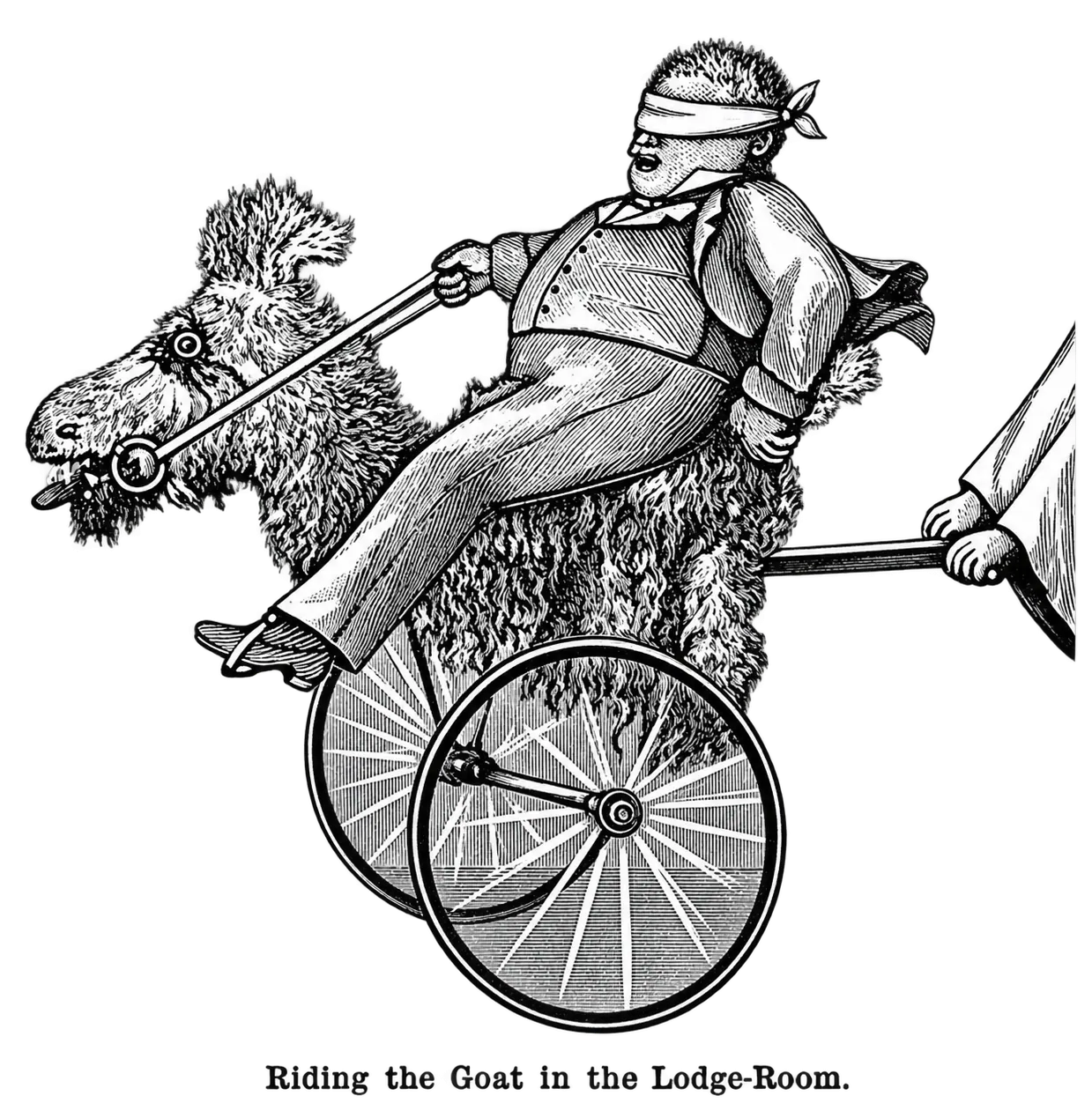
Ram—the goat—was worshiped at Mendes as sacred to Osiris. His worship was similar to that of Apis, the bull, but still of a grosser and more sensual form. The goat was to the Egyptians the symbol of the productive power in nature.