Chapter VI
Pythagoras
Many Masonic writers consider Pythagoras as “the grand-father” of Masonry. In many lodges he is introduced as the teacher to the candidate and many signs and symbols are taken from his school. He was the son of a lapidary, and the pupil of Pherecydes, and flourished about five hundred years before Christ. Posterity has been very liberal to him in bestowing upon him all such inventions as others had neglected to claim, particularly in music and mathematics; and there is hardly any part of science with which his followers did not endow him. Jamblichus asserts that he traveled extensively through Egypt, India and Europe, and came in contact with the sages of those countries. Returning to his home, Samos, he wished to communicate the benefit of his researches to his fellow-citizens, and with this view he established a school for their instruction in the elements of science; proposing to adopt the Egyptian mode of teaching, and to communicate his doctrine under a symbolical form. But the Samoans were either too stupid or too indolent to profit by his instructions. Although he was obliged to relinquish his design, he did not altogether abandon it. In order to engage the attention of his countrymen by some other means, he repaired to Delos; and, after presenting an offering of cakes to Apollo, he there received, or pretended to receive, moral dogmas from the priestess, which he afterwards delivered to his disciples under the character of divine precepts. About the beginning of the fifty-ninth Olympiad he left Greece and established himself at Crotona in Italy. In order to obtain credit with the populace he pretended to have the power of performing miracles and practised many arts of imposture. Clothed in a long white robe, with a flowing beard, and, as some say with a golden crown upon his head, he preserved among the people, and in the presence of his disciples, a commanding gravity, and majesty of aspect. He had such a command over himself that he was never seen to express in his countenance, grief, joy or anger. The influence of his teaching, to which he gave the name of philosophy, extended from Crotona to many other places and obtained for him from his followers a degree of respect little short of adoration. By his artificial demeanor Pythagoras appeared among the vulgar as a being of an order superior to the common condition of humanity, and persuaded them that he had received his doctrine from heaven, and that Apollo, Minerva and the Muses had often appeared to him and instructed him. He founded a secret society and had in a short time six hundred members. Previous to the admission of any person into this fraternity, Pythagoras examined his features and external appearance, inquired how he had been accustomed to behave towards his parents and friends; marked his manner of laughing, conversing and keeping silence; and observed what passion he was most inclined to indulge; with what kind of company he chose to associate; how he passed his leisure moments; and what incidents appeared to excite in him the strongest emotions of joy or sorrow. To teach his disciples humility and industry, he exposed them for three years to a continued course of contradictions, ridicule and contempt, among their fellows. That they might acquire a habit of entire docility, he enjoined upon them, from their first admission, a long term of silence, sometimes for five years. Pythagoras taught after the Egyptian manner, by images and symbols, obscure and almost unintelligible to those who were not initiated into the mysteries of the school; and those who were admitted to this privilege were under the strictest obligation of silence with regard to the recondite doctrines of their master. That the wisdom of Pythagoras might not pass into the ears of the vulgar, it was committed chiefly to memory; and when they found it necessary to make use of writing, they took care not to suffer their minutes to pass beyond the limits of the school. One of his principles was that not everything is to be told to everybody, and that his followers ought not to speak but when required to do so, expressing thereby that secrecy is the rarest virtue. Jamblicus relates, as evidence of the brotherly love of the disciples of Pythagoras and their means of mutual recognition, the following incident: “A Pythagorean, traveling in a distant country, fell sick and died at a public inn. Previously to his death, however, being unable to compensate the landlord for his kindness and attention with which he had been treated, he directed a tablet, on which he had traced some enigmatical characters, to be exposed on the public road. Some time after another disciple of Pythagoras passed that way, perceived the tablet, and learning from the inscription that a brother had been there sick and in distress, and that he had been treated with kindness, he stopped and reimbursed the innkeeper for his trouble and expense.” Mathematics, and especially geometry, were the principal studies he enjoined upon his followers, as the first step towards wisdom. The sum of all the principles of Pythagoras is this: The Monad is the principle of all things. From the Monad came the indeterminate Duad, as matter subjected to the cause of the Monad; from the Monad and the indeterminate Duad numbers, points; from points lines; from lines superficies; from superficies solids; from these solid bodies whose elements are four—Fire, Water, Air, and Earth—of all which transmuted, and totally changed, the World consists.
The region of the air was supposed by Pythagoras to be full of spirits, demons or heroes, who cause sickness or health to man or beast, and communicate by means of dreams and other instruments of divination, at their pleasure, the knowledge of future events. He professed to cure diseases by incantations, and taught the transmigration of souls. It is related of him that on one occasion he interceded in behalf of a dog that was beaten because he recognized in its cries the voice of a friend. After his death, Pythagoras was held in great esteem by his followers and especially during the third century of our era was held up by the Alexandrian school as the equal to Christ.
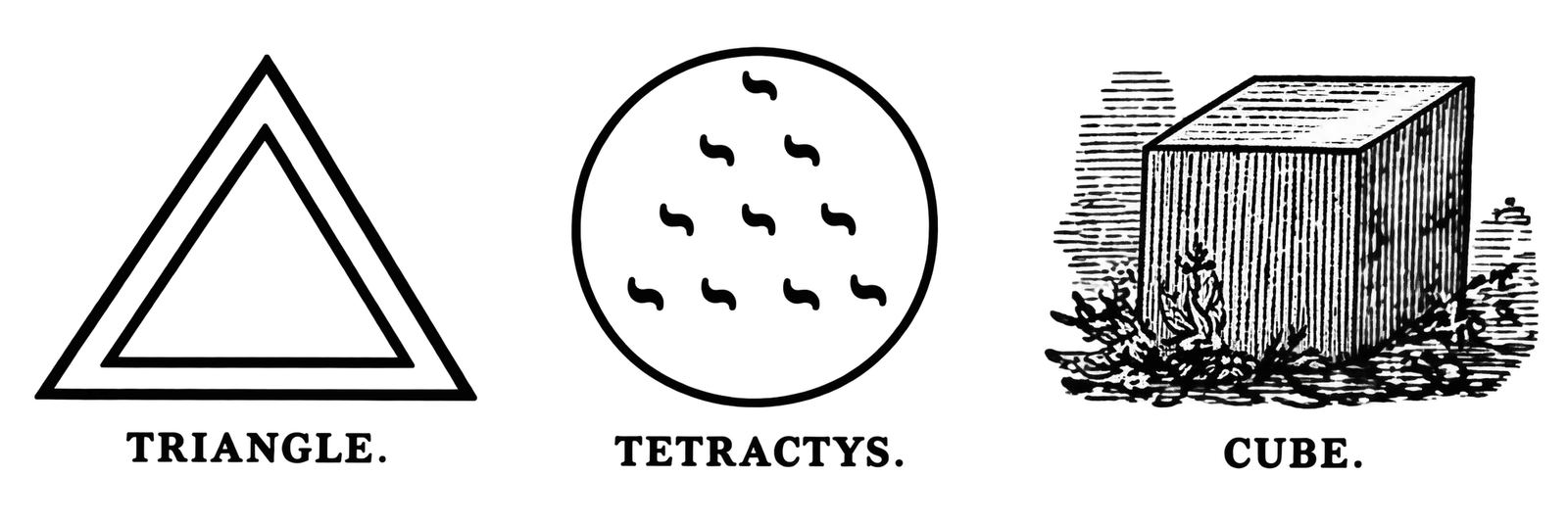
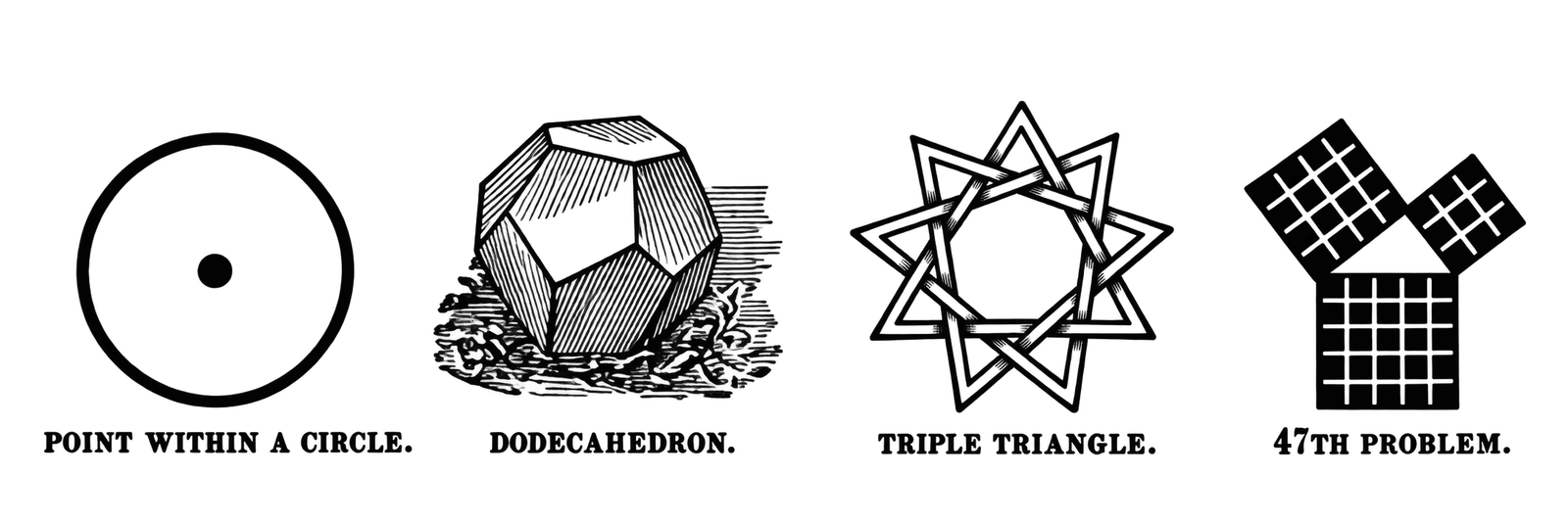
The esoteric or secret instruction of Pythagoras were explained with the aid of symbols, as the readiest and most efficient method of impressing upon the mind of the candidate for the mysteries the sublime truths and moral lessons for which the school of that justly celebrated philosopher was distinguished. A few of the most important symbols are here explained. The Equilateral Triangle, a perfect figure was adopted among the ancient nations as a symbol of Deity, the principle and author of all sublunary things; the essence of Light and Truth, who was, and is, and shall be. The square comprehends the union of the celestial and terrestrial elements of power; and was the emblem of morality and justice. The Tetractys was a sacred emblem, which was expressed by ten jots disposed in the form of a triangle, each side containing four. This was the most expressive symbol of Pythagoras. On it the obligation to the aspirant was propounded; and it was denominated the Trigonon mysticum, because it was the conservator of many awful and important truths which are explained as follows: The one point represented the Monad, or active principle; the two points the Duad, or passive principle; the three points the triad, or the world proceeding from their union; the four, the Quarternary, or the liberal sciences. The Cube was the symbol of the mind of man, after a well spent life in acts of piety and devotion, and thus prepared by virtue for translation into the society of the celestial gods. The Point within the Circle was the symbol of the universe. The use of this emblem is coeval with the first created man—the creation was the circle and himself the center.1 The Dodecahedron, or figure of twelve sides was also a symbol of the universe. The Triple Triangle—a unity of perfectness—was a symbol of health, and was called Hygeia. The Forty-seventh proposition of Euclid was invented and explained by Pythagoras, and is so extensively useful that it has been adopted in all Lodges as a significant symbol of Freemasonry. The letter Y was a symbolical representation of the course of human life. Youth, arriving at manhood, sees two roads before him, and deliberates which he shall pursue. If he meet with a guide that directs him to pursue philosophy, and he procures initiation, his life shall be honorable and his death happy. But if he omits to do this, and takes the left hand path, which appears broader and better, it will lead to sloth and luxury; will waste his estate, impair his health, and brings on an old age of infamy and misery.
Notes
In the ages of idolatry and the worship of Phallus and Linga the point within a circle bore a more immediate relation to the generative principle of nature, symbolized by the union of the sexes. Does it stand for any other symbol in the lodge rooms of to-day?
↩
