Chapter XXVII
Knights of Pythias
This Order of Knighthood is a secret society, founded in 1864, at Washington, D. C., by prominent Freemasons. The ceremonial is founded on the story of Damon and Pythias, and the principles are: Friendship, Charity and Benevolence, with the motto “Be Generous, Brave and True.” The first or initiatory rank is that of Page; the second, the Armorial rank of Esquire; and the third, the Chivalric rank of Knight.
The Chaplain in the Order of Knights of Pythias is called Prelate. At the opening of a “Castle,” as the meetings are called, he says:
Prelate (standing): “My station is at the left of the Chancellor Commander, opposite the altar. My duties are to administer the obligation, to offer invocation to the Deity and ask His blessing upon our brotherhood; and to perform all other services required of me by the laws of the Order and the by-laws of this Lodge.”
The Chancellor, explaining his duties, asks:
“What is the duty of every member of this Lodge?”
All: “To avoid anger and dissension; to work together in the spirit of fraternity; to exemplify the friendship of Damon and Pythias.”
Chancellor Commander: “To aid us in this work, the Prelate will invoke the divine assistance.”
Prelate: “Supreme Ruler of the Universe, we humbly ask Thy blessing upon the officers and members of this Lodge. Aid us to avoid anger and dissension; help us to work together in the spirit of fraternity; and inspire us to exemplify the friendship of Damon and Pythias. Hear and answer us, we beseech Thee. Amen.”
All: “Amen.”
Opening Ode
“God bless our knightly band,
Firm may it ever stand,
Through storm and night.”
“When the wild tempest rave,
Ruler of wind and wave,
Do Thou our Order save
By Thy great might.”
“For this our prayers ascend,
God bless, protect, defend,
God guard our rights;
Thou who art ever nigh,
Viewing with watchful eye,
To Thee aloud we cry
‘God save the Knights.’”
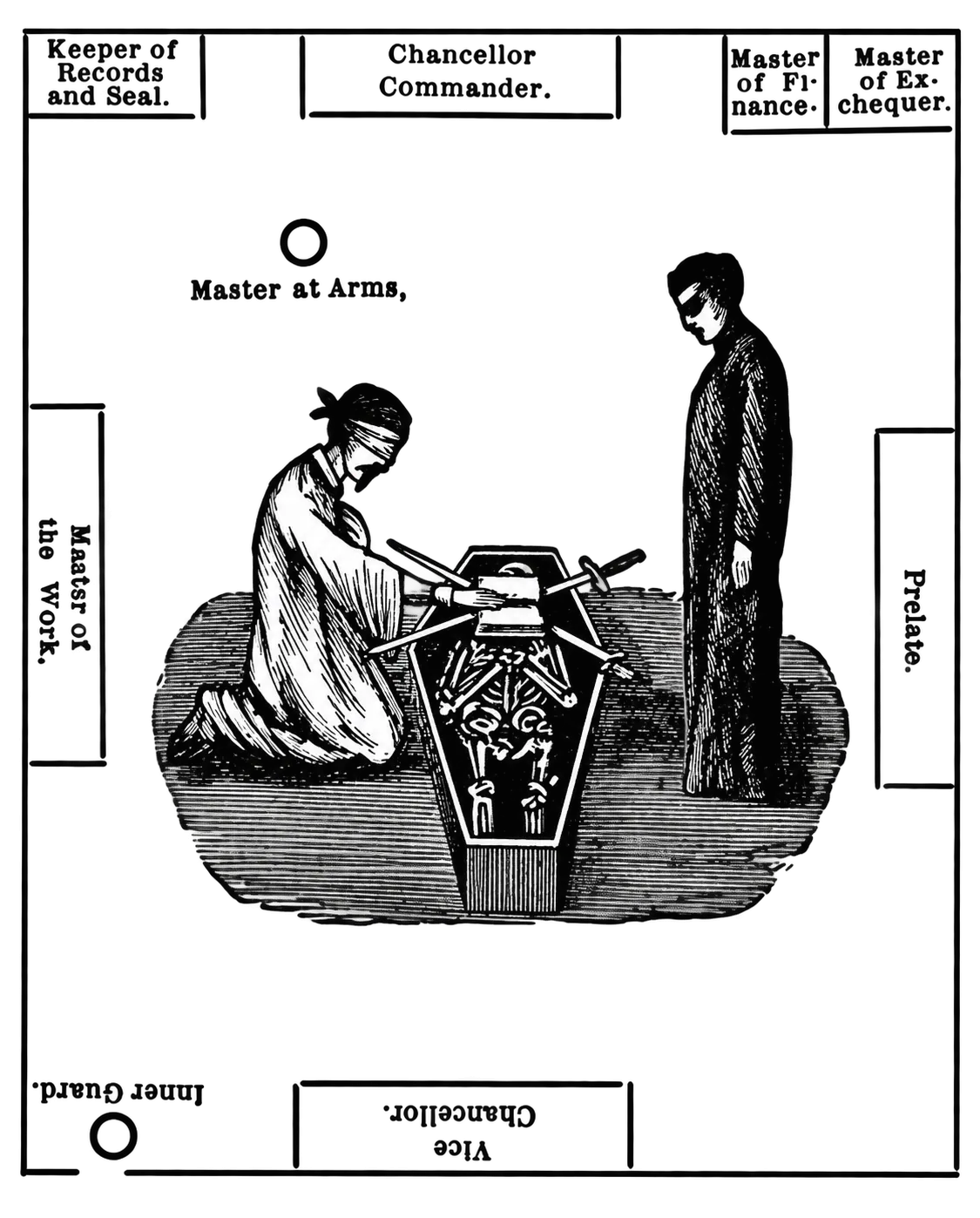
The Master-at-Arms goes up to the altar, opens the book of laws and places the sword of defense in proper position.
At the initiation for the rank of Page the ritual prescribes:
“On two trestles, twelve inches high, covered by a black pall reaching to the floor, shall be placed an open coffin, which shall contain a skeleton. On the coffin shall be two crossed swords, with the hilts towards the Prelate, and on these the open book of law.”
The candidate is blindfolded and a white sash, extending from the right shoulder to and below the left hip, is put upon him.
When he is brought before the Prelate this official says:
“… Master-at-Arms, require the stranger to kneel upon both knees, place his left hand upon his left breast, and his right hand, palm downward, on the book of law.”
The hoodwink is removed and the candidate says: “I, N. N., solemnly promise that I will never reveal the password, grip, signs, or any other secret or mystery of this rank, except in a Lodge of this Order, recognized by and under the control of the Supreme Lodge Knights of Pythias of the World, or when being examined by the proper officers of a Lodge, or to one whom I know to be a member of this rank. I further promise that I will not become a member of, recognize or countenance any organization using the name of this Order or any derivative thereof, which is not recognized by and under the control of the Supreme Lodge Knights of Pythias of the World. I further promise that I will obey the laws and, as far as possible, comply with the requirements of the Order. I further promise that I will heed the teachings of this rank, and seek to profit thereby; and, as I meet the members of this Order, I will endeavor to exemplify, in my conduct and my demeanor toward them, the principles of friendship embodied in the lesson of to-night. To the faithful performance of this obligation I pledge my sacred word of honor. So help me God, and may He keep me steadfast.”
All: “Amen.”
Prelate: “Stranger, by this vow you are bound until death.”
All: “Even unto death.”
(A short advice is given, an anthem sung):
“In the deep hush o’er the earth is stealing,
Father, I come to thee;
In humbleness of heart I bow, appealing—
Be merciful to me,
Be merciful to me.”
Patriarch: “You will now arise. My friend, you have pledged your sacred word of honor—man can give no higher pledge. You have called upon the Ruler of the Universe to aid you in keeping the obligation inviolate.”
(Between candidate, master-at-arms and vice-chancellor a conversation takes place till candidate is brought before the station of vice-chancellor.)
Master-at-Arms: “Vice-Chancellor, I present to you a friend who desires to receive further instructions.”
V. C. (standing): “How am I to know that he has taken the obligation of the rank of page?”
M. A.: “He is in possession of a sprig of myrtle.”
V. C.: “What does the myrtle symbolize?”
M. A.: “The friendship which bound Damon to Pythias.”
V. C.: “How should we exemplify that friendship?”
M. A.: “By the practice of fraternity.”
V. C.: “I accept the emblem (takes it from him) as an evidence of your intention to join us in the practice of fraternity; and I will now instruct you in the secret work of this rank.”
(This is done, and then candidate is brought before the Chancellor Commander, who standing says):
“The friendship of Damon and Pythias shines through the mists of centuries, a glowing tribute to the humanity of the past. It was made the sweet song of ancient Greece, and is immortalized in the permanence of our order.”
“Damon, a senator of Syracuse, had incurred the displeasure of Dionysius,1 and was under sentence of death. Many delighted to honor him when he wore the robes of office; now he had but one friend in all Syracuse, the companion of his brighter, better days. Pythias was true, and knowing Damon’s love of home, he begged the tyrant to grant his friend a respite, that he might see his wife and child before he died, and offered himself as a hostage, as a pledge for Damon’s return. The fervor of this strange request touched the heart of Dionysius. It was to him a mystery. He granted the request, and Pythias became a hostage for Damon, who hastened toward home by the distant sea. The mystery deepens—the tyrant cannot solve it. By this decree, in the lone dungeon where Pythias wears the chains, the fair Calanthe urges her lover to break his bond and fly with her where danger cannot come. He will not go; he has pledged his word; honor is more to him than life, and in his refusal the tyrant marvels still more.”
“Will Damon return? The love of home, of wife and child, the tender memories that shine like burning stars through the gathering gloom, hold him, until, ere he knows, the last hour of respite is hastening by. Giving a last fond embrace to his loved ones, a last longing, lingering look at his once happy home, he starts for Syracuse to redeem his promise and save his friend.”
“The hour of execution is at hand; Damon has not returned and his hostage is brought to the block to suffer in his stead. The evening sun shines golden on the towers and temples of ancient Syracuse as Pythias looks out among the vast throng, who taunt him with the seeming falseness of his friend. Relying upon the honor of Damon, trusting in his word, proud of his friendship, he calls upon the gods to prevent his return, and, in response to the cruel jeers of the mob, proclaims the fidelity of Damon, and turns to meet his fate.”
“At the last moment, when the headsman’s axe is raised, a horseman is seen in the distance, coming with the speed of the wind.”
“It is Damon—he has been true to his promise. He has saved his friend. The air resounds with the shouts of the populace, in recognition of a virtue that has long been buried under the weight of human selfishness. At the strange scene the tyrant looks in wonderment, and as he looks, the cruel purpose of the hour passes away, and friendship sits upon the throne, wearing the crown ‘that ne’er encumbers nor can be transferred.’ The heroes still live, and will live while friendship warms the heart of man. This virtue is the corner-stone of the Order, and our members are sworn to exercise it toward each other.”
“Keep sacred the lesson of to-night; and so live that when you come to the river that marks the unknown shore, your hands may be filled with deeds of charity, ‘the golden keys that open the palace of eternity. I now confer upon you the rank of Page in the Order of Pythias,’” (invests the candidate with a blue collar.)
In conferring the second degree or Rank of Esquire, the Master-at-Arms brings the candidate before the Prelate and says:
“Prelate, by order of the Chancellor Commander, I present a Page that you may administer to him the obligation of the rank of Esquire.”
Prelate: “Advance your left foot, place your left hand upon your breast, close your right hand, raise your right arm as if to strike a downward blow, and repeat after me:”
“I, N. N., solemnly promise that I will never reveal the password, grip, signs or any other secret or mysteries of this rank, except in a Lodge of this Order, recognized by and under the control of the Supreme Lodge, Knights of Pythias of the World, or when being examined by the proper officers of a Lodge, or to one whom I shall know to be a member of this rank.”
“I specially promise that I will not commit to writing any of the secret work of this Order, so that it may become known; nor will I permit it to be done by another, if in my power to prevent.”
“I further promise, so far as may be in my power, to guard the good name of a member of this or any other rank of this Order, and I will not speak ill of him until I am satisfied, by careful investigation, that he has disregarded his obligation, has violated the laws of his country, or has been guilty of conduct unbecoming a gentleman. I further promise that in my dealings with men, I will endeavor to be careful, cautious and prudent; and for the frailties of others will exercise the same charity I would ask for myself.”
“To the faithful observance of this obligation I pledge my sacred word of honor. So help me God and may He keep me steadfast.”
In initiating the candidate for the rank of Knight the Master-at-Arms brings him to the dark room and puts him in charge of a Monitor, who gives him a lengthy admonition and closes the same by saying:
“The darkness which surrounds you is symbolic of life. Man sits in gloom, and the purpose of his existence is a mystery.”
“Thus shut out from the light of day ‘the world forgetting, by the world forgot’—learn now from me the highest purpose of our Order. As you are now helpless, alone, an unmanned bark upon an unknown sea, your heart-beats the only chart and log-book, hear what I would say; and as you hear, resolve that from the ashes of the past you will arise, and, in the spirit of Pythian fidelity, do your duty to your fellows and to your God.”
After some more talk of this kind the candidate is placed in company with Pythagoras, who addresses him thus:
Pythagoras to Candidate: “In me behold Pythagoras. Centuries before your eyes had opened upon the light of day, I had attained the knowledge of all the ages. The arts of ancient Egypt, the science of Arabia and the philosophy of Phœnicia, the lore of the Chaldean sages and the occult mysteries of the Persian Magi, are to me an open book. I welcome you as a seeker after knowledge; but bear in mind, O neophyte, this truth—the wish to know contains not always the faculty to acquire. He who seeks to discover must first learn to imagine and to deliberate. The life that contemplates is nobler than the life that enjoys. He who merely is, may be a dull, insensate hind; he who is, is in himself divine. The journey which is before you is to you unknown. It lies, perhaps, through flower bespangled plains and verdant meads, where summer sunshine shifts through interlacing boughs, and perfumed zephyrs sigh, and music throated birds entrance the listening ear. It peradventure winds its devious and uncertain way along the mountain-side, where unscaled peaks their towering summits lift amid the thunder’s sullen roar, and depths abysmal yawn beyond the treacherous precipice, or else where darkling rivers run, ’mid rayless gloom, through caverns measureless to man, down to a sunless sea. Mayhap it leads through bog and fen and foul morass, where hideous creatures climb and crawl, and slimy serpents cling and coil, and nameless, countless horrors lurk unseen. Fear is the deadliest foe of knowledge. Be brave. The coward fancies perils which may not exist, and dies a thousand deaths; to the hero danger comes only to nerve his arm and steel his soul to combat and to conquer. And now, farewell. You go to claim the golden spur that knighthood wears. To wear it you must win it. Should you succeed, your guerdon and reward will be companionship with loyal-hearted and chivalric knights; should you fail, on you and you alone will rest the burden of the blame.” (The Senate Chamber is now prepared, and when the Senators have taken their seats the King enters and the Herald cries:)
Herald: “The King.”
King (having taken his position and is standing): “Is every Senator in his proper place?”
Herald (saluting): “All are present, sire.”
King: “With knightly courtesy I greet you.” (Senators salute.) “Be seated, Senators.” (King and Senators take seats. Herald and attendants remain standing.) “Senators, you are the chosen guardians of the portals through which must pass all who would attain the honors of Pythian knighthood. Your decisions are supreme and from your edicts, once formally pronounced, there is no appeal. As senators, pledged to protect our Order against the intrusion of those unfit to wear the armor of a Knight, I urge you to be ever on your guard, and to let nothing swerve you from the line of Pythian duty. Do not measure value by the effrontery which is too often the mask of cowardice, nor count as fear the gentle mien that is frequently the guise of sterling manhood. Seek always to have the full and perfect measure of him who craves from you the honor of the knightly spur. In all you do, be just and yet be merciful. Remember,”
“Wise were the kings who never chose a friend
… till they had unmasked his soul
And seen the bottom of his deepest thoughts.”
“There is present an Esquire who seeks to stand upon the summit of Pythian knighthood. Avouching his readiness to undertake any duty, to undergo any test, which your wisdom may prescribe, he awaits with confidence your decree. Ere he is brought before you, I have but this to say: To be held worthy of the high honor that he craves, brave must he be, a lover of the right, a foe forever of the wrong, ready to do all and to dare all for the cause of truth.”
The First and Second Senators make their speeches as soon as the candidate is brought in the room and the Third Senator says:
“I wish for him a thorough test, that all may see the truth of boasted valor, and that, when he shall prove that he is worthy of it, he may gain and hold our warmest friendship. And so, let him be made to leap upon a score of spikes of steel, set firmly in a solid slab of oak; and as he does, let each one look and listen, to see if in his face he show the pallid flag of fear, or by any groan give token of a coward soul.”
Each of the eight or more senators gives his advice about the test, when a vote is taken and the King declares: “The test of steel.” The real test is a triangular piece of heavy wood, about eighteen inches or two feet long on each side, and about two inches thick, bristling with steel spikes, the points carefully sharpened, and the whole making a most gruesome-looking instrument of torture. The fictitious test is an exact reproduction of the real test, excepting that the steel spikes are replaced by spikes made of soft rubber, painted so as to resemble those of steel.
King: “Esquire, you will carefully examine the instrument, and fully satisfy yourself as to its composition. (Pauses until candidate has examined the test.) You see that it is a solid slab of oak, in which are firmly set sharp spikes of steel. Executioners, place the test. This test may seem to you cruel and uncalled for; and while there is much I dare not reveal, I wish to say: A moral coward is often tempted to deeds of reckless daring, rather than face the jeers of those about him. A man of courage and noble purpose will by no act of his do violence to his manhood. With confidence in himself and in his friends, prudence marks his conduct and success crowns his life. With this admonition, and the assurance that you are to be the judge of what is prudent, I bid you meet the test. Master-at-Arms, conduct the Esquire to the test.”
(The Master-at-Arms conducts the candidate to a seat near the steps, requires him to remove his shoes, and causes him to stand upon a platform of several feet high, the fictitious test lying on the ground floor.)
King: “Esquire, you have presented yourself as an aspirant for the honors of knighthood, avowing your readiness to undergo any test that might be imposed on you. The wisdom of the Senate, after full debate, decreed the test of steel. That decision is supreme, from that edict, thus formally pronounced, there is no appeal. Therefore I bid you instantly to leap, with both feet, upon those spikes of steel.”
(If candidate fails or refuses to obey, the King will order):
“Executioners, do your duty.”
(The attendants will at once seize the candidate firmly, but without violence, and place both feet upon the test.)
The Chancellor Commander gives instruction to the new Knight, and says, among other things: “In the test you were called upon to meet, we sought to impress you that a Knight of Pythias should be obedient to every official command, and that, with confidence in his brethren, he should fearlessly do his duty. …”
The usual oath is taken and the explanation of the symbols, signs, etc., given.
The principal objectionable features, for reason of which the Catholic Church has forbidden its members to join the Knights of Pythias, and demanded a withdrawal of those who had joined it, are:
First, the oath of secrecy by which the member binds himself to keep secret whatever concerns the doings of the Order, even from those in Church and State who have a right to know, under certain conditions, what the subjects are doing.
Secondly, this oath binds the member to blind obedience, which is symbolized by the test. Such an obedience is against the law of man’s nature, and against all human and divine law.
Thirdly, Christ is not the teacher and model in the rule of life, but the Pagan Pythagoras and the Pagans Damon, Pythias and Dionysius.
In 1895, a large number of German Knights of Pythias, on account of a question as to the use of the German language in the meetings, seceded and formed the “Improved Order of Knights of Pythias.”
There are two organizations of wives, daughters, sisters and mothers of Knights of Pythias, the Rathbone Sisters and the Pythian Sisterhood. The Order is extending all over the world.
Notes
NOTE—This is the Dionysius, of whom history, among many other things, tells us this: “Dion, the philosopher, one day gave a sharp reproof to him on account of his cruelty. Dionysius felt highly offended and resolved to avenge himself on Dion. So he took the son of Dion prisoner, not indeed, to kill him, but to give him up into the hands of an irreligious teacher. After the young man had been long enough under the teacher to learn from him everything that was bad and impious, Dionysius sent him back to his father. The object he had in view was this: He foresaw that this corrupted son, by his impious conduct during his whole lifetime would cause the father constant grief and sorrow, so much so that he would be for him a life-long affliction and curse. This the tyrant thought was the longest and greatest revenge he could take on Dion for having censured his conduct.”
↩
